Many hands make light work: Increasing capacity for the monitoring of African penguins on Bird Island
SANPARKS SIGNIFICANTLY INCREASED MONITORING, COMPLIANCE AND MAINTENANCE EFFORTS ON BIRD ISLAND WITH THE HELP OF SEVEN DEDICATED SEABIRD MONITORS FUNDED BY AN IUCN-SOS GRANT TO WILDERNESS FOUNDATION FOR A YEAR
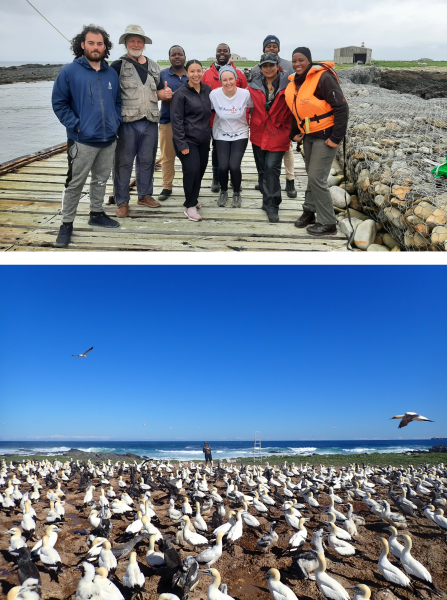
Additional monitoring support funded through Wilderness Foundation has greatly increased monitoring efforts on Bird Island, Addo Marine Protected Area. Bottom: Area of nests monitored in a portion of the Cape gannet colony on Bird Island, Addo Marine Protected Area. Cape gannets are endangered and intensive monitoring contributes to effective conservation of these birds (Photos: Zamokuhle Lazola and Peter Atholl).
The iconic African penguin is facing a crisis. These charismatic birds, once abundant along the west coast of South Africa and Namibia, have experienced a significant decline over the past century.
While historical factors like guano and egg harvesting played a role, the current decline is primarily attributed to a scarcity of food near colonies. SANParks has the responsibility of safeguarding 55% of the remaining African penguin population found on St. Croix and Bird Islands in Addo Elephant National Park Marine Protected Area (MPA). Ongoing declines in these populations have been linked to increased shipping activities associated with ship-to-ship bunkering operations in Algoa Bay. The rising frequency of large vessels entering the bay has led to elevated noise levels, disturbance, displacement, and pollution, all of which negatively impact penguins.
SANParks, in conjunction with Wilderness Foundation, have increased monitoring and compliance efforts on Bird Island through the appointment of seven dedicated seabird monitors funded by an IUCN-SOS grant for a year. Stationed on the island on a three week rotation, these passionate individuals play a crucial role in increasing monitoring and surveillance efforts, while also assisting with law enforcement and maintenance on the island.
Monitors have helped gain a clearer understanding of Kelp gull abundance and activity within the penguin colony. They have noticed a greater number of gull adults before the penguins start to breed (Sep-Nov) followed by an increase in gull juveniles during the breeding season (Jan-Mar) with the highest abundance recorded in January.
Additional capacity on the island has also made monthly counts of nesting Cape gannets possible. While these counts were previously conducted only 1-2 times a year when researchers visited the island, seabird monitors have enabled consistent monthly data collection, and a more reliable estimate of gannet breeding success. In addition, they assisted in ringing 1000 Cape gannets this year alone. The presence of the monitors in the colony has also greatly boosted observational capacity, notably for injured or distressed birds, which would otherwise go unnoticed.
Apart from ensuring that data gathering progresses with little to no gaps, monitors also support SANCCOB
(Southern African Foundation for the Conservation of Coastal Birds) with rescue and rehabilitation efforts.
This article was originally published in the 2022/2023 Research Report.

