Killer whales drive white sharks away: A shifting predator seascape
EVIDENCE SUGGESTS THAT KILLER WHALES ARE DISPLACING WHITE SHARKS FROM THEIR TRADITIONAL
AGGREGATION SITES IN THE WESTERN CAPE
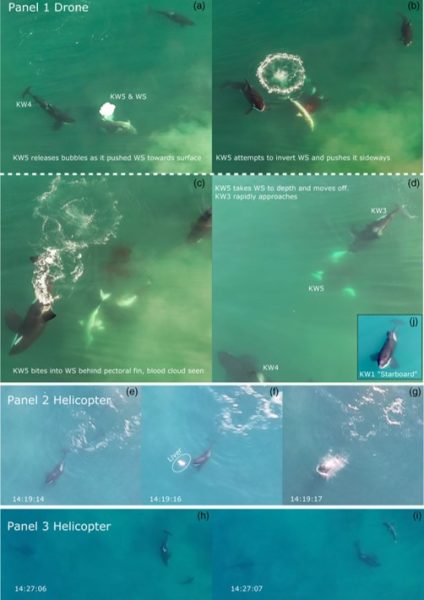
Series of images taken off Hartenbos Beach, Mossel Bay, South Africa. Panel 1: screen grabs from the video filmed from a drone by Christiaan Stopforth showing the first confirmed observation of a group of killer whales killing a white shark. Inset in (d) shows killer whale 1, an animal with a bent dorsal fin known as “Starboard,” one of the pair of killer whales previously implicated in shark predations in South Africa, which was part of the group. Panel 2: A series of photographs taken on a mobile phone from a helicopter (D. Archer, Mossel Bay Helicopters) showing the potential consumption of a free-floating shark liver. Panel 3: Screen grabs from a video taken on a mobile phone showing the circling behaviour of a white shark avoiding a killer whale while a second killer whale approaches.
The presence of apex predators profoundly affects land and ocean ecosystem structure and function. While losing top predators can disrupt ecosystems and trigger trophic cascades, the introduction of novel apex predators remains poorly understood. In our study, we documented the emigration of white sharks at a prominent white shark aggregation site in South Africa in response to novel predation pressure by killer whales. We also studied the impact of this predation risk on predator-prey dynamics. Highly unusual events occurred between February and June 2017 in Gansbaai.
Five white shark carcasses were discovered on beaches, with distinct wounds and missing livers. Through careful investigation, we identified the likely culprits behind these occurrences. The mysterious shark deaths were due to two killer whales, specifically two known shark-hunting specialists, Port and Starboard. Their presence in the area coincided each time with the appearance of the deceased sharks, providing clear evidence of their involvement.
Through careful analysis of sightings per unit effort and telemetry data, we discovered that white sharks left
Gansbaai in response to the predations and presence of killer whales. Tagging data provided more compelling
evidence, showing that some sharks ventured far away from their usual habitat in response to a predation
event. Overall, white shark sightings at the aggregation site significantly declined, and the absence of white
sharks increased after each predation event, eventually resulting in complete abandonment of the site for 2.5
years.
This study showed profound differences from traditional white shark behaviour at Gansbaai. Typically, the sharks would stay at this site year-round, but the presence of the killer whales triggered an immediate flight response and prolonged absence in the area. The absence of white sharks, in turn, created a void that another predator, the bronze whaler shark, filled.
In our first study, we relied on examining shark carcasses to confirm killer whales as the predators, with no direct observations of this predatory behaviour. Shortly after, extraordinary videos by a hobbyist drone and a
helicopter pilot provided undeniable evidence of killer whale predation on white sharks off the coast of Mossel
Bay. The drone and helicopter footage revealed unique behaviour employed by the killer whales during the
predation event. One killer whale held a white shark in a semi-inverted position, potentially inducing a motionless state known as tonic immobility. The killer whales appeared to use a specialised foraging tactic, focusing on the energy-rich liver of the sharks while leaving the rest of the carcass behind.
The study also gave new insights into sharks’ attempts to evade capture by killer whales. On two occasions, killer whales approached sharks closely and slowly. Instead of fleeing as one might expect, the shark stayed
close to the killer whale, circling it and keeping it in view – a common strategy that seals and turtles use to evade sharks. However, killer whales are social and hunt in groups, and we believe the circling strategy is ineffective for white sharks when two or more killer whales are present, as the shark cannot keep more than one killer whale in view at a time, enabling a second killer whale to ambush the shark. Following the predation events, there was a significant change in the behaviour of white sharks in Mossel Bay, as we had documented in Gansbaai. Observations by beachgoers, drone flight data, and encounters by commercial white shark cage diving operators indicated that white sharks fled the area and remained absent for several weeks (Fig. 1). This response suggests that the fear induced by killer whale predation can profoundly impact white shark populations.
The implications of killer whale predation on white sharks are far-reaching. The South African white shark population, already small and facing numerous human-induced threats, experienced further displacement
from their natural aggregation sites due to the presence of the shark-hunting killer whales. The consequences
extended beyond ecological impacts. The tourism and filming industries, heavily reliant on the presence
of white sharks, suffered severe financial losses as the smaller shark species took over the once-popular aggregation sites. Fortunately, these industries have adapted to the changes and have started marketing diving with these smaller species of sharks with some success.
These findings demonstrate how the fear induced by top predators can lead to significant changes in predator
behaviour and subsequent ecological shifts. The consequences extended beyond ecological impacts. The tourism and filming industries, heavily reliant on the presence of white sharks, suffered severe financial losses as the smaller shark species took over the once-popular aggregation sites. Fortunately, these industries have adapted to the changes and have started marketing diving with these smaller species of sharks with some success.
Killer whales displacing white sharks raises challenging questions regarding the management of these apex predators. Traditional solutions for terrestrial predators, like translocation, fences or removal of damage-causing animals, do not apply to endangered, intelligent, and wide-ranging marine species. Perhaps the only feasible option is to continue researching the drivers behind this novel behaviour, assess its potential transmission within the killer whale population, and quantify the overall impacts on white sharks, killer whales, the ecosystem, and the livelihoods dependent on them.
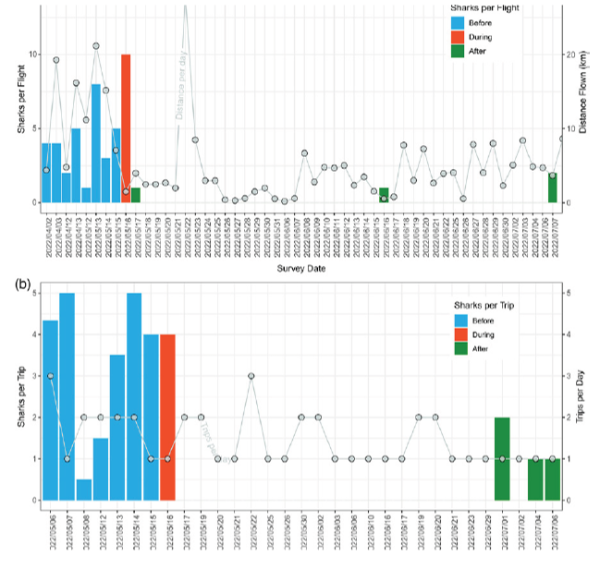
Figure 1. Bars show the number of white sharks observed per drone flight (a) and commercial cage diving trip (b) in Hartenbos, Mossel Bay area, before, during, and after a predation event where two killer whales attacked and killed a great white shark. The line shows the total flight distance per day for drone flights from pilot logbooks (a) and the number of trips per day (b).
This article was written by Alison Kock and Alison Towner and originally published in the 2022/2023 Research Report.

This article is based on publications in African Journal of Marine Science and Ecology journals
Towner AV, Watson RG, Kock AA, Papastamatiou Y, Sturup M, Gennari E, Baker K, Booth T, Dicken M,
Chivell W & Elwen SH. 2022. Fear at the top: killer whale predation drives white shark absence at South
Africa’s largest aggregation site. African Journal of Marine Science, 44(2), 139-152.
Towner AV, Kock AA, Stopforth C, Hurwitz D, & Elwen SH. 2022. Direct observation of killer whales preying
on white sharks and evidence of a flight response. Ecology 27:e3875
