Have you seen the golden mole? Improved monitoring of species of special concern within Kruger
A PROCESS OF PRIORITISING THE MONITORING OF SPECIES OF SPECIAL CONCERN IN KRUGER NATIONAL
PARK IS CONTRIBUTING TO MUCH BETTER DISTRIBUTION DATA FOR SPECIES
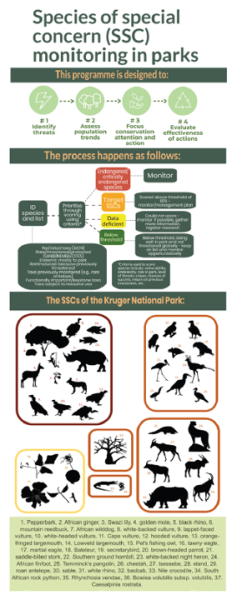
Art: Corli Coetsee.
In a park with thousands of plant species, and hundreds of animal species, how do you decide which ones to monitor? SANParks scientists have been thinking about this for a while. Work that was started in the late 1990s by Freitag and Van Jaarsveld was published in 2011 as part of SANParks Biodiversity Monitoring Programme: Species of Special Concern. More recently, with the revision of the Kruger Park Management Plan, this process was used to develop the Species of Special Concern lower-level plan. In short, all potential species of concern were listed, then prioritised in terms of monitoring urgency and importance and lastly, a monitoring programme was developed (see infographic).
1 Listing
‘Species of Special Concern’ is largely an administrative designation or grouping used within SANParks. Species may be listed for a wide range of reasons, including being internationally or nationally listed as threatened; endemic with most of their range confined to a national park; having locally threatened populations within South Africa, even if they are doing well elsewhere; or listed under CITES. Species may also be of special concern for other reasons, such as being a functionally important or keystone species; so common that they impact other species; subject to resource use and legitimate sustainable (or illegal) harvesting within parks; or with high social or cultural value.
2 Prioritisation
All species on the initial list are prioritised through several scoring categories: their conservation status, the importance of various threats to the species, how important they are in terms of their ecological role as well as tourism potential, etc. We then summed the scores in each category and expressed this as a percentage of what the maximum score is that a species could attain. Regardless of their internal score, species that were listed as critically endangered or endangered were automatically added to the priority list (as red) as SANParks is mandated to monitor these. Species that scored higher than 65% were added to the priority list (as orange) and these are now monitoring priorities. This exercise was done for mammals, birds, plants, fish, and reptiles (see infographic for the priority species).
3 Monitoring plans
The various species of concern identified in Kruger require different monitoring methods. Many of the larger animals can be monitored via aerial census. Others can be monitored by field rangers while on patrol. However, some of the species need dedicated research because they are hard to identify or rarely seen. These include Juliana’s golden mole, which lives underground, or species, such as otter, pangolin or python, which are rarely encountered. Based on these factors, a monitoring programme that combined a range of monitoring tools was implemented around mid-2022 in Kruger. This included using species sighting information recorded not only on Cybertracker, but incorporating various social media platforms i.e., Birdlasser and iNaturalist. All this information is summarised in the quarterly Biodiversity Monitoring Report for Kruger.
And no, nobody has seen the golden mole yet since this process was started, but we hope in future to be able to monitor this rarely seen species.
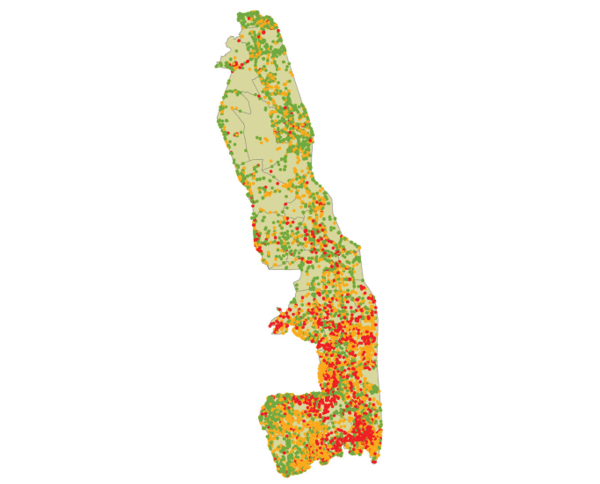
Species of special concern recorded during the 2022-23 financial year through the use of the various platforms (e.g., Cybertracker, iNaturalist, Birdlasser). Elephants sightings were not included. The new process of monitoring species of special concern has increased distribution data immensely (Map: Chenay Simms).
This article was originally published in the 2022/2023 Research Report.


