Cultural heritage research in SANParks
Cultural heritage management, research and tourism is justly receiving increasing attention in SANParks, with several initiatives (1) promoting and facilitating a diversity of cultural heritage research projects, (2) securing cultural heritage assets and (3) enabling broader access to the many and varied cultural heritage sites in the park, as part of the tourism experience.
The Cultural Heritage Unit has undertaken initiatives to ensure that heritage management within national parks is given the attention it needs and deserves.
Improving cultural tourism within national parks
SANParks is one of the main custodians of natural and cultural heritage in South Africa, with many conservation successes over the years. However, these successes have mainly involved the conservation of biodiversity, with far less to report on cultural heritage conservation. In fact, in some cases, cultural heritage has been lost, ignored, or not protected. Additionally, a lack of research has resulted in large gaps regarding our knowledge and understanding of history. Importantly, there is a need for more effective management of cultural heritage sites, as well as making more sites in SANParks accessible to tourism. Although many visitors are attracted by the rich biodiversity in parks, some are specifically interested in the cultural heritage and much more can be done to provide tourists with a greater and varied cultural heritage tourism experience. To this end, many new cultural heritage sites have been identified across parks. For instance, in the Kruger National Park, a selection of Iron Age dry stone-walls have been identified for restoration, subsequent to opening for tourism under the supervision of a trained guide.
Improving cultural heritage research within national parks
While there are active cultural heritage research projects in various national parks, there are limitations to the scale and scope at which this is taking place. SANParks hope to broaden the geographical area in which archaeological research is being conducted. First, collaboration with University of Pretoria (UP) on archaeological research in Kruger National Park, is informed by a clear five year strategic plan. It is our intention to also explore research possibilities in other parks, such as the Iron Age sites in Marakele and the rock art in Kruger and Mapungubwe. Secondly, we have signed a Memorandum of Understanding with University of Venda for collaboration on common areas of interest with regards to the research and management of archaeological heritage in SANParks. Through this collaboration, we collectively exhumed a human grave in Mapungubwe in November 2021. This grave had been discovered directly in front of staff accommodation at the Schroda residential area. Thirdly, to showcase cultural heritage research projects that are being conducted either within or nearby our protected areas, we intend publishing a Special Issue of the Koedoe journal towards the end of 2023. This publication will profile a variety of research areas including archaeology, palaeontology, and heritage.
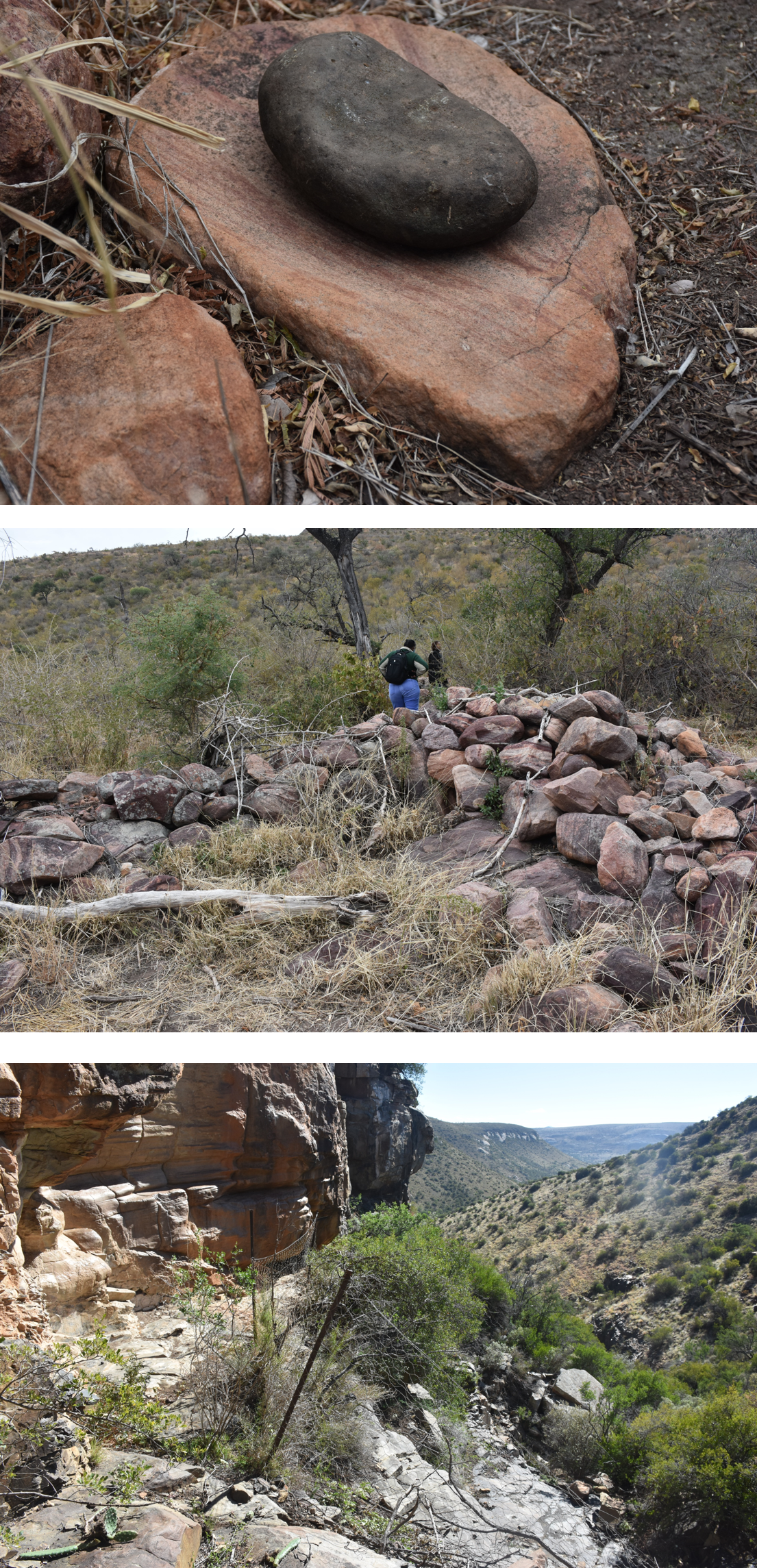
Cultural heritage sites include sites from different periods. Top: Lower and upper grindstones from one of the Iron Age sites in Marakele National Park. Middle: Dry-stone walls in Marakele National Park. Bottom: A view from one of the rock art sites in Mountain Zebra National Park (Photo: Ndukuyakhe Ndlovu).
Measures taken to mitigate erosion of cultural heritage sites in Mapungubwe National Park
Mapungubwe National Park is located within a landscape that has national and international significance as a declared National and World Heritage Site. There are three primary archaeological sites that characterise the importance of the landscape, namely, Schroda, K2, and the Mapungubwe Hill. Over time, these sites have been subjected to challenges, including erosion (especially at Schroda and K2), posing risks to their long-term persistence. In the early 2000s, various mitigation interventions were undertaken to safeguard Schroda, including the placement of gabions in strategic places. In 2021, a field visit assessed the functionality of old gabions in reducing erosion, and to build new gabions where needed. Gabions that were no longer functional either due to damage or placement were removed, and new gabions were built to control the intensity of water run-off in specific areas of the site. One of these new gabions was erected at K2 where sand from an old excavation was causing excessive erosion of both the substrate and the archaeological artifacts contained within the disposed material. This was threatening both the archaeological integrity and tourism experience of the site. To mitigate this, a partly submerged wall was built, grass will be planted and used in combination with a polymer surface covering to stabilise the site.
The mitigation measures at both Schroda and K2 were made possible through funding provided as an outcome of the Vele Colliery Biodiversity Offset Agreement between three entities: South African National Parks, Department of Forestry, Fisheries, and the Environment, and the MC Mining Limited.
Furthermore, four new rock art sites have been identified for development as tourist sites. This process requires that stringent measures be taken to safeguard the archaeological deposits from potential damage from visitors and animals prior to opening the sites. A Section 35 archaeological permit was secured from the South African Heritage Resources Agency (SAHRA) to implement the identified protection measures which shall be undertaken in mid 2022.
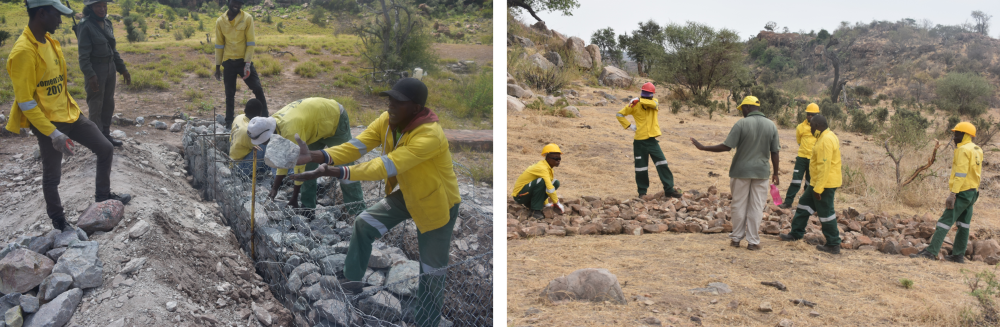
Mitigation work to control erosion of archaeological materials in Mapungubwe National Park include left, a retaining wall at K2 and right, erosion containment at Schroda (Photo: Ndukuyakhe Ndlovu).
Cultural heritage assessments at Marakele and Mountain Zebra National Parks
During the 2021/2022 financial year, cultural heritage surveys were undertaken at both Marakele and Mountain Zebra National Parks. The main aims of these physical surveys were to (i) review and verify the list of known heritage sites and movable cultural assets, (ii) assess the state of preservation for each of the known sites, (iii) identify and explore heritage sites with tourism potential, (iv) identify areas and sites with research potential, and (v) remove all sites from the database that were erroneously added. Park management now have fully revised heritage databases of these parks, as well as an action plan to safeguard the long term persistence of sites that are threatened by various factors.
Heritage assessments in Mountain Zebra National Park have resulted in the identification of two new rock art destinations, which will require the building of a wooden deck, pathways and the development of a detailed rock art narrative for tourists guides, before they can be officially opened to the public.
This article was written by Ndukuyakhe Ndlovu and originally published in the 2021/2022 Research Report.