Assessing 20 years of managing ornamental alien plants in Kruger – are we succeeding?
ALIEN ORNAMENTAL PLANTS HAVE BEEN MANAGED IN KRUGER FOR TWO DECADES. A SURVEY IN 2020 AIMED TO DETERMINE WHETHER THE PROGRAMME WAS ACHIEVING ITS GOALS, WITH MIXED RESULTS. WHILE SOME MANAGEMENT INTERVENTIONS HAVE BEEN SUCCESSFUL, OTHER SITUATIONS HAVE WORSENED

Some of the many ornamental alien plant species found in gardens throughout Kruger National Park (Photos: Llewellyn Foxcroft).
Globally, the introduction of alien ornamental (“garden”) plants is known to be an important pathway of plant invasions. Following a survey of ornamental plants in Kruger between 1999 and 2003, a policy was developed to guide the management of alien ornamental plants, which was subsequently implemented. The core of the policy was focused on ornamentals on the invasive plant lists from the Conservation of Agricultural Resources Act, and with subsequent revisions to the policy, later included the National Environmental Management: Biodiversity Act and its Alien and Invasive Species Regulations.
Policies are developed and management plans implemented, but long-term success is not often assessed. Insights into how successful implementation has been, and which aspects have and have not worked, assist managers in refining the plans. A recent assessment aimed to assess whether Kruger is achieving its aims to manage alien plants, and shed light on both promising outcomes and areas of concern.
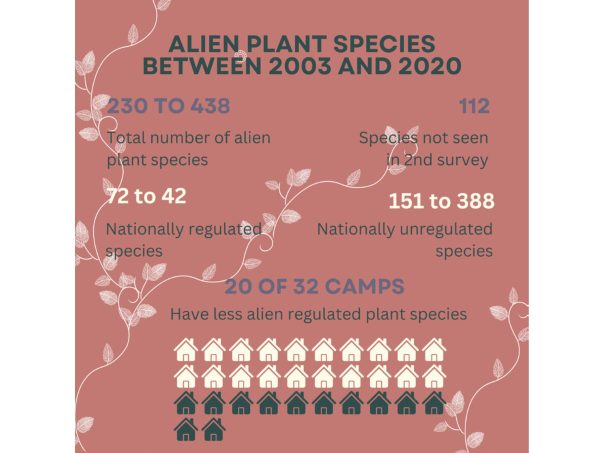
In 2020, all tourist camps, staff villages and remote human inhabited areas such as ranger outposts were extensively resurveyed. Species identified were categorised into three groups: nationally regulated (i.e., legislated species), locally regulated (i.e., species listed as a concern in Kruger) and unregulated species (i.e., alien species not listed in the regulations or not of primary concern at the time of compiling the management plan). The results were a mixed bag, both disappointing and encouraging, and provided valuable insights into the effectiveness of alien plant management in Kruger.
The disappointing finding was that the total number of alien ornamental species increased from 231 species in the 1999-2003 survey to 438 species in 2020. The good news was that the presence of regulated species decreased. Unfortunately, unregulated species increased massively (see infographic for statistics).
There are caveats, however. The 2020 survey was more intensive than the initial surveys and therefore the increase in total species richness may not be as high as it appears. Additionally, there was no abundance or density data collected in 1999-2003, which limits our ability to draw definitive conclusions. For example, where there may have been extensive alien plants in gardens that were removed (present in high numbers before), species may persist at low numbers through regrowth or germination from old seeds at present, leading to a continued listing of their presence. This therefore does not provide a clear reflection on the substantial reduction in the overall abundance of ornamental alien plants in Kruger.
This article was originally published in the 2022/2023 Research Report.

This article is based on a publication in Biological Invasions
Keet J-H, Datta A, Foxcroft LC, Kumschick S, Nichols GR & Richardson DM. 2022. Assessing the level of compliance with alien plant regulations in a large African protected area. Biological Invasions 24: 3831–3844.
