An alien invasive species dominates catches in an estuarine fishery
IN CONTRAST TO OTHER ESTUARINE SYSTEMS, THE TOUWS ESTUARY FISHERY IS DOMINATED BY MOZAMBIQUE TILAPIA, A FRESHWATER SPECIES
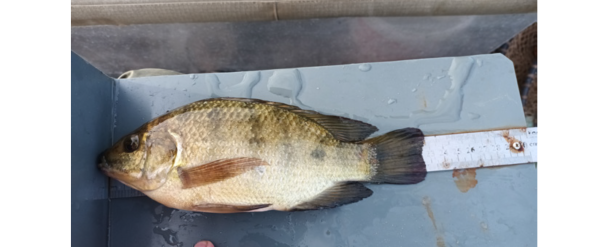
Mozambique tilapia caught at Island Lake; this invasive species is targetted by anglers resulting in reduced pressure on indigenous estaurine-dependent fish species (Photo: Kyle Smith).
Estuaries, often places of great scenic beauty, are highly productive ecosystems and provide a range of goods and services. Unfortunately, this makes them focal points for development and use, with associated deterioration of habitats and processes. Thus, managing the multiple demands placed on estuaries is essential to ensure that they continue to provide benefits.
Many estuarine-dependent fish populations have declined due to overfishing and environmental degradation,
which places the sustainability of estuarine line fisheries in question. Pressures include high targeting rates of vulnerable species, high retention rates and the large proportion of undersized fish being retained. However, few formal fishery assessments have been undertaken.
The Wilderness Lakes and Touws Estuary is an example of a system where estuarine fish populations are declining. Park zonation permits line fishing and bait harvesting within the interconnected Eilandvlei, Serpentine and Touws Estuary. To assess where and how much fish and bait harvesting occur in the system, monthly surveys and interviews were undertaken in 2022 and 2023.
Over a year, 36 surveys were completed during which 204 anglers were encountered. Fishing effort was higher over weekends but, interestingly, interviews indicated that some anglers avoided Eilandvlei over weekends due to entrance fees. Fishing effort decreased over winter, with the highest fishing effort recorded in the autumn months (March to May). Surprisingly, 42% of anglers targeted Mozambique tilapia, an extralimital freshwater species listed as one of the world’s hundred worst invaders. Nevertheless, this active targeting of a freshwater invasive species reduced fishing pressure on endemic estuarine-dependent fish species, such as white steenbras, Cape stumpnose and spotted grunter.
In general, 74% of fish caught were retained, but retention rates varied among species. For example, all leervis were released, but 88% of white steenbras, a species listed as endangered on the IUCN Red List and whose adult population is estimated at being 96% depleted, were retained and all were undersized. Furthermore, almost all Cape stumpnose and 40% of spotted grunter retained were undersized, placing the future of these populations in jeopardy. Mozambique tilapia have no minimum size limit and 82% were retained.
The Touws Estuary line fishery is the first estuarine fishery to be assessed where the target species and dominant catch comprises a freshwater species.
This article was originally published in the 2022/2023 Research Report.

