Current Tuskers
When a new tusker is identified, current policy requires that they be named after their home range or characteristics unique to the individual tusker.

Bidzane (Photo by Arks Smith)

Botsotso (Photo by Gerhard Windisch)

Hahlwa (Photo by Rian Boshoff)

Kukura (Photo by Ian Whyte)
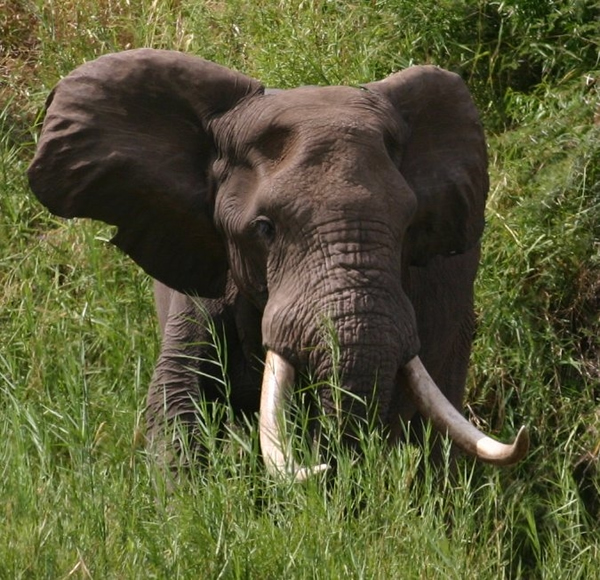
Machachule (Photo by David Johnson)
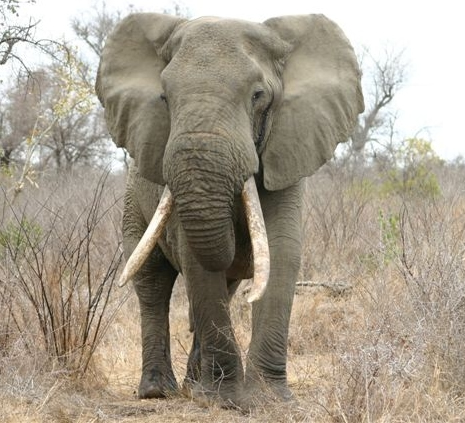
Madolo (Photo by Matthew Durrel)
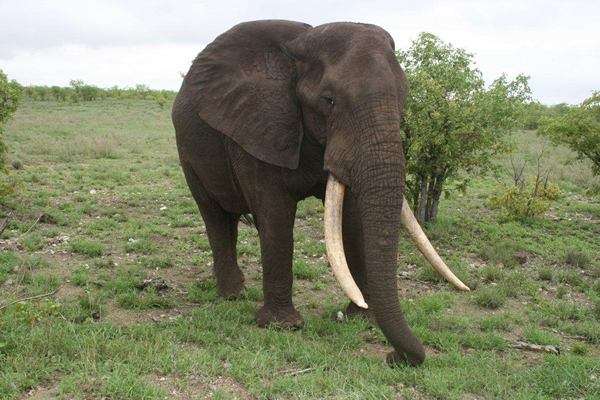
Masasana (Photo by Dr Ian Whyte)
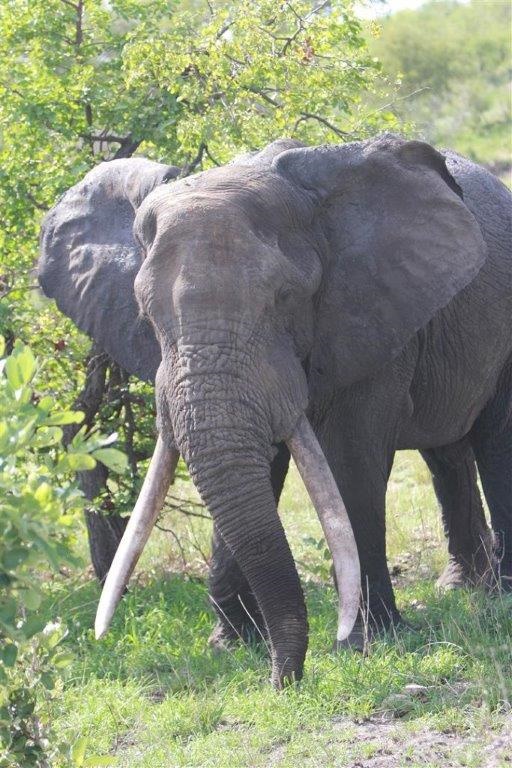
Matlakusa (Photo by Joel Roerig)
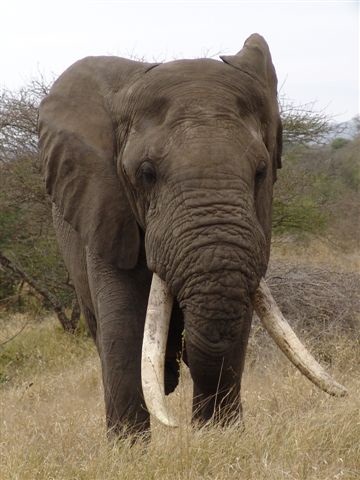
Mavalanga (Photo by Robert Bryden)
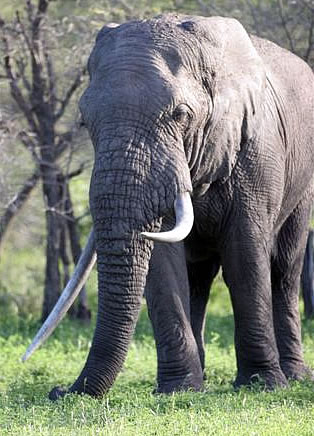
Mbazo (Photo by Nicole Cordes)

Mondzweni (Photo by Dave Jackaman)

Nambu (Photo by Sannette Boshoff)
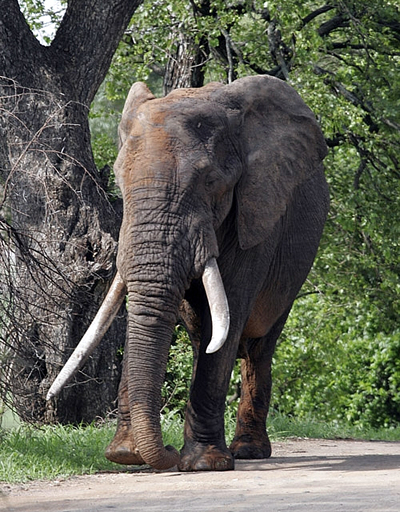
Ngonyama (Photo by Christiaan Janse van Rensburg)

Ngunyupezi (Photo by Joep Stevens)
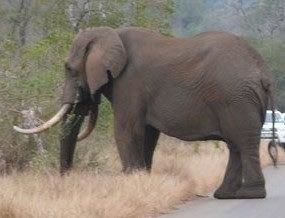
Ngwenya (Photo by Mark Scheepers)
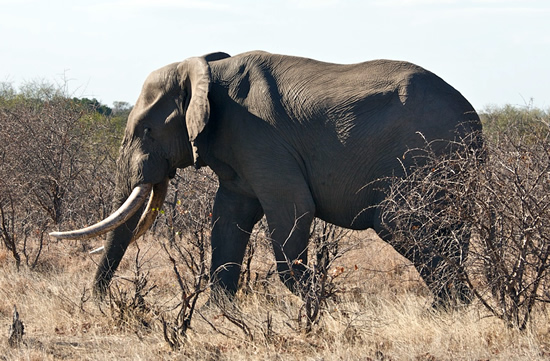
Ntombazana (Photo by Anja Stolk)
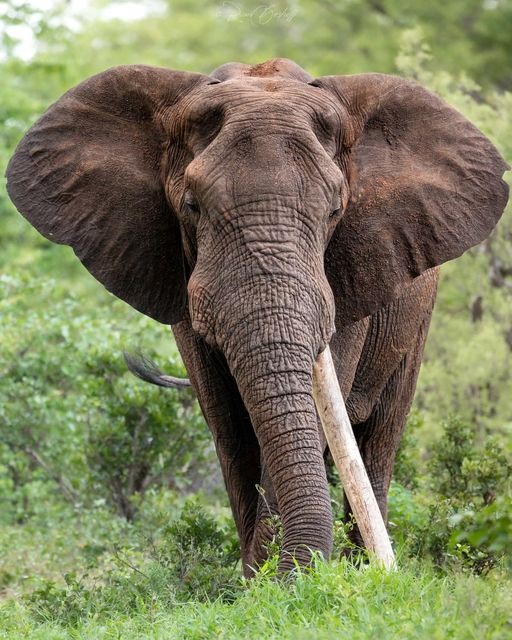
Ntsena (Photo by Rian Boshoff)

Nwashinangana (Photo by Barry Swart)

N’watindlopfu (Photo by Tara-Lynn Svensson)
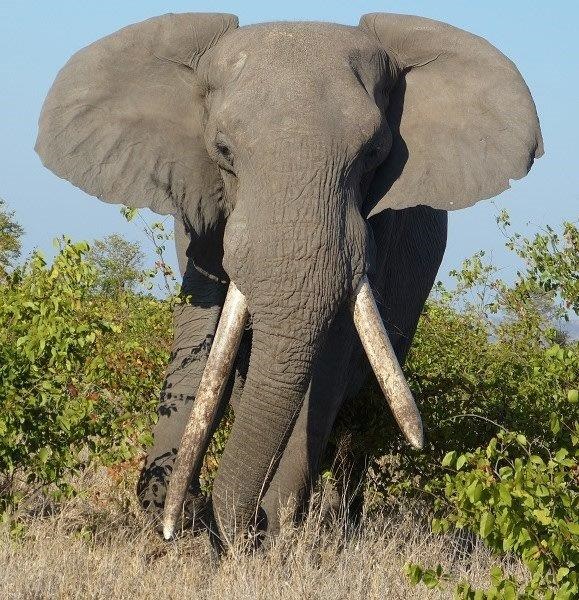
N’wendlamuhari (Photo by Anton Jeffery)
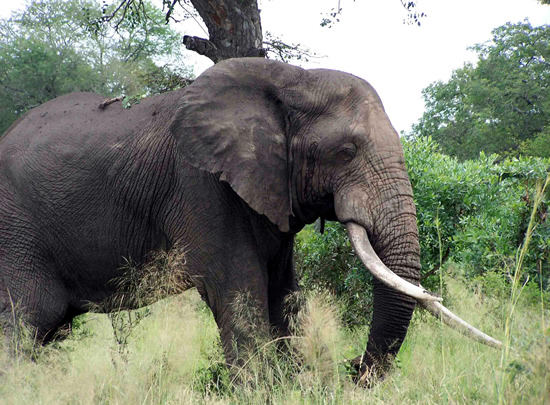
Thandamamba (Photo by Jenni Lane)
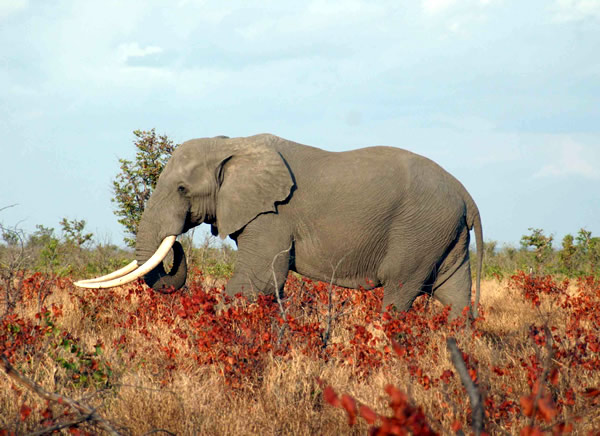
Timaka (Photo by Dr Ian Whyte)

Tsotsi (Photo by Sarah Webb)
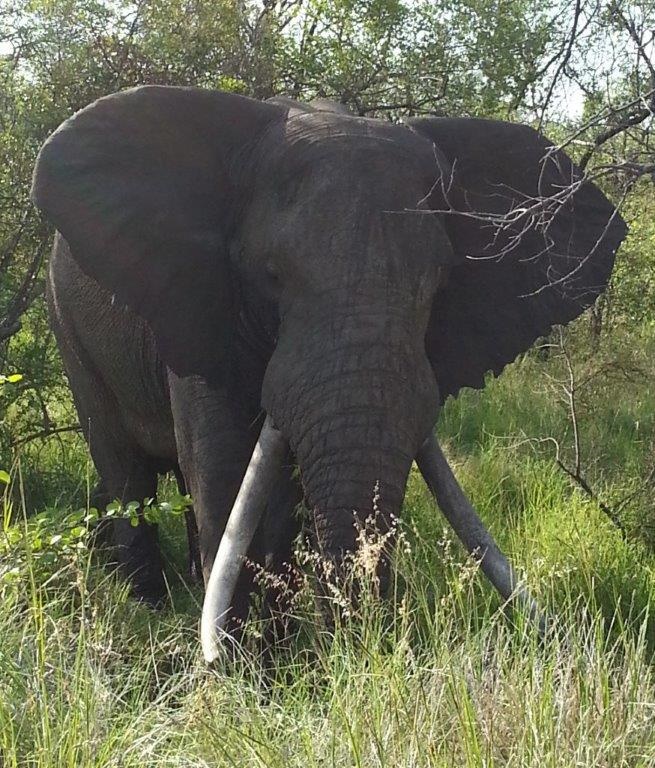
Vusopfa (Photo by Gary Flockhart)
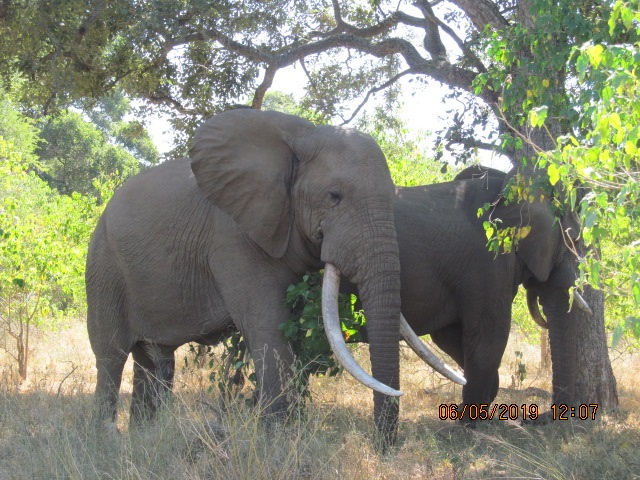
Xidudla (Photo by Kirsty Redman, SANParks)
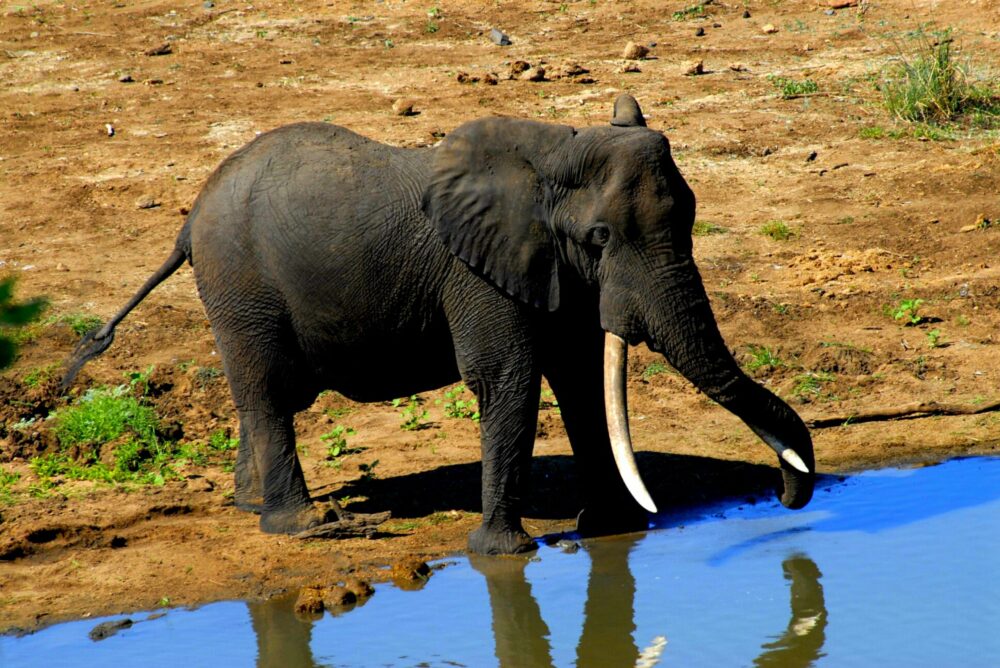
Xindzulundzulu (Photo by Tara-Lynn Svensson)
Bidzane
Origin of Name
Named in memory of Gus Adendorff who served as a ranger in the Kruger National Park for 27 years. (‘Bidzane’ is Swahili and refers to the zebra skin band around the hat that Gus always wore)
Range
North of Letaba
Special Features
Large v-shaped tear/notch in the middle of the left ear lobe, notable hole approximately the size of R2 coin about 10cm below the tear. Bidzane’s ivory is not exceptionally substantial at this time, but has the potential to develop. His ivory is fairly symmetrical with the left tusk curving more then the right.
General
The existence of this bull was initially questionable as he bears a remarkable similarity to Timaka, a known bull who at a time frequented the same area. A detailed submission received in April 2006, by Ms Arks Smith, showed the identification characteristics of this bull and served to clearly highlight the very subtle difference between the two bulls and allowing his existence to be confirmed. He was named in 2007 during the judging of the 2006 Emerging Tuskers competition and was the 1st prize winner for Ms Smith in this competition. Subsequent to his naming, previous submissions thought to be Timaka were able to be distinguished through the markings as Bidzane and showed that the bull had been noted as early as 2005. Bidzane is a young bull, but definitely has the potential to become one of the substantial tuskers.
Botsotso
Origin of Name
‘Botsotso’ is Tsonga and refers to particular style of jeans that were worn in the olden days and is a direct reference to the large very prominent folds of skin on the rear of this bull making it one of his identification characteristics’.
Range
This bull has a slightly larger home range then some of the other bulls, he has been sighted just North of the Tropic of Capricorn to north of Shingwedzi and Babalala.
Special Features
Once again we have a bull with similar tusk shape to Matlakusa and Xindzulundzulu although this bulls straight and symmetrical ivory is not as widely splayed and shows a curve inwards of both tusks towards the bottom when seen from a frontal view. His most notable ear markings are found on his left ear. At the bottom on the lobe there is a deep u-shaped tear in the tip of the lobe. Further up towards the middle of the lobe there is a small v-shaped notch in the outer lobe, above this towards the top of the lobe there is a deeper w-shaped notch, both of these are only visible in high resolution images. In earlier images there are signs that the right tusk experienced a small break, this has subsequently smoothed over and the re-growth has allowed the tusks to remain fairly symmetrical. The right lobe lacks any significant markings. The trunk does offer a few characteristics’ namely at the lip line on the right tusk there is a scarring growth that looks like a tennis/golf ball between the tusk and trunk. A wound picked up in 2016 on the lower left leg has healed forming a golf ball sized lump/cyst which can now be prominently seen.
General
This is another bull that started out being monitored slowly as there was only one submission of him by Brian McCullum in 2010. A further single submission by Terry de Souza in 2011 confirmed the identifying characteristics of this bull, however it was still felt that with limited submissions he should continue to be monitored. In 2014 – 2016 sightings of the bull increased dramatically and it was decided to confirm his status as a large bull by naming him. Sadly an image received on the 27th October 2019 by TeddySa (Gerhard Windisch) indicated that Botsotso may have broken his left tusk. The characteristic ear markings in these images were not visible making confirmation difficult, adding to the uncertainty were earlier sightings in October showing the tusks intact. An image posted on the Kruger Sightings group in December 2019 showed the characteristic ears markings and the tusk break clearly allowing the break to be confirmed. Visually he has lost approximately 50% of his left tusk.
Hahlwa
Origin of Name
The name ‘Hahlwa’ Tsonga meaning ‘twin’ was given to this bull due to the background and history towards his final identification. The tusks and the ear markings of this bull resemble almost identically those of Masasana and in many images would seem to be his twin.
Range
This bull has a large range and while sighted predominately at Shingwedzi he has been seen regularly further south in the Tihongonyeni, Middleveli and Letaba areas.
Special Features
This tusker has easily identifiable features although these can easily be confused with those of Masasana whose features are almost identical with the exception of the notch in the right ear. The right tusk of this bull was slightly longer and straighter then the left tusk which has a small curve at the tip. The tusks are close together from a frontal view and from a side profile look straight. In December 2019 (submission by Rian Boshoff) it was noted that Hahlwa had suffered a severe break to his right tusk approximately 30cm from the lipline.
The left ear has a w-shaped notch with a piece skin hanging in the middle forming the ’w’ shape towards the middle of the ear, the right ear has a wide square notch visible on the lower right. An oval tennis ball sized growth is also visible on his upper left front leg but this is not always prominently seen in images. The thickening on the trunk closely resembles the thick line markings on Masasana although with a small variation in shape towards the center of the trunk and top left close to the ivory lip.
General
This bull caused large confusion with his initial sightings in October 2015 by Kobie Naude and Tara-Lynn Svensson in Shingwedzi, primary due to the majority of the bulls identification markings being virtually identical to Masasana but as the bull was sighted in an area considered unusual for Masasana who had remained local to Letaba. Despite close scrutiny of all the identifying features by several experts’ confirmation of his identity could not be offered at the time. The ‘new’ notch in the right ear left the questions namely was this Masasana extending his home range due to the dry conditions prevailing in the KNP in 2015/16. A distinct possibility as many known bulls had changed their ‘traditional’ movements due to water shortages? Did he pick up a new notch in the right ear which would not be unusual either? Or did we have a new bull?
A definitive answer to these questions could not be made until confirmed sightings of Masasana were received in the Letaba area as the bulls were just too similar. Fortunately the wait was not long and a sighting of the ‘twin bull’ in late January 2016 by Jan Momberg in the Shingwedzi River area and Masasana at Letaba in March 2016 by Matt Axel confirmed that there were in fact two bulls. The sighting of Masasana was fortunately clear and showed both ears and markings notable missing the square notch on the now confirmed Hahlwa.
Subsequent to this confirmation, Hahlwa has been seen on several occasions between Letaba and Shingwedzi.
Sightings of Hahlwa close to Shingwedzi on 25th December 2018 from Rian Boshoff (seen again on the 29th December) and a second one from Richard Brauch on the 29th December 2018 supporting the report confirmed that Hahlwa has broken his right tusk rather severely with only approximately 30 -45cm left extending from the lip line on the right side. Prior to this the last confirmed sighting of him with both tusks intact was from Dries de Wet in April 2018. This is unfortunately a large time frame in which to establish when the actual break may have taken place but hopefully further historic sightings from 2018 will be received and we will be able to narrow this gap down.
Kukura
Origin of Name
Kukura is Shona meaning “growing” referring to the speed at which this bulls tusks developed from Emerging to Larger Tusker status in a short space of time.
Range
Northern Satara/Letaba. This bull predominates the northern central region but has been recorded as far north as Letaba.
Special Features
Kukura has tusks that are fairly symmetrical with the right tusk curved slightly higher than the left. The ivory is also on the thinner side when compared to other large bulls. This bull is quiet distinctive in that the left ear is partially floppy. In addition to the partial floppy nature of the left ear with a tendency to fold backwards there are a few notable notches. In the lower lobe towards the tip is a shallow u-shaped notch, in the upper top section of the lobe often hidden in a frontal view in the folds is a deep but narrow u-shaped notch. Below this towards the mid lobe a small misshapen v-shaped notch can be seen. The right ear has less distinctive notches, in the lower lobe is a wide very shallow scooped shaped notch. Towards the top of the lobe, a deeper u-shaped notch not visible from a frontal view. Kukura’s trunk has developed a few scared areas, most notably thickened nodules between the tusks at the lip line level and slightly below.
General
The first submission of this bull was made in 2015 by ex-regional ranger Louis Olivier (see Mandleve) in the Bangu area of the Kruger National Park, at the time his tusks were not significant enough to considering naming him and it was decided to monitor him. No significant change was observed by late 2018 when he was under review for renaming.
However a number of submissions made in early 2019 with the most significant and clear one being on the SANParks Forum by Marj Atkins showed exponential growth in the bull’s ivory. At this stage it was decided after consultation with the naming committee that due to the development to put the bull forward for naming. Sightings of this bull continue to increase as he develops with him being a popular sighting in the central region.
Machachule
Origin of Name
Machachule has been named in memory of Corporal Joe Managanyi who served 33 years service for the Kruger National Park. (Machachule meaning ‘the lead dancer’ this name was given this name by his staff as he was known as a very strict worker who did not waste time and who had to do things immediately, leading by example).
Range
Shingwedzi
Special Features
Large uneven v-shaped tear in the right ear towards the middle of the lobe, top part of the v-shape more elongated then the bottom. Left ear has a medium sized square shaped notch towards the middle of the lobe, small flap of skin directly below this.
General
Machachule, was discovered initially by Dr Ian Whyte (SANParks) in the Shingwedzi area, during the aerial census in 2004. This bull was noted as to be watched but seemed to have kept a low profile with only a few known recording of him, in 2006 by Grant Knight recorded him again during the aerial census, and a guest Jose van der Hoorn noted him in November 2005 and May 2006. This was until recently when numerous sightings were recorded in 2007, and it would seem he has now become a regular feature for guests in the Shingwedzi area. This bull was named in 2008 during the judging of the 2007 Emerging Tuskers Competition year.
Joe ‘Machachule’ Manganye (1935 – 2005)
Joe was a long serving member of the SANParks family. Joe retired as a Field Ranger Corporal from the Mahlangene Section of the Kruger National Park in 2002, after 33 years service.
Madolo
Origin of Name
Named in honor of Johan Kloppers who served 36 years in conservation in the Kruger National Park (Madolo meaning ‘Knee’s’, was given to Johan due to his penchant for walking. According to staff who knew him well he inherited this name due to his unique stride when walking)
Range
Skukuza/Kruger Gate towards Pretoriuskop.
Special Features
Symmetrical ivory with left tusk slightly longer then the right. Mandolo had relatively clean ears however there are small v-shaped notches in the left ear, towards the centre and lower sections of the ear lobe, a small hole below the lower notch in the left ear is also visible.
General
This bull has been seen on two occasions by the same person Mr Matthew Durell who on both occasions provided a detailed photographic series providing a comprehensive data base of this bull. This bull was named in 2008 during the judging of the 2007 Emerging Tuskers Competition and was awarded 3rd prize in the same competition.
Masasana
Origin of Name
‘Masasana’ a Tsonga word meaning ‘One can always make a plan’ was named in recognition of Johan Sithole who served the Kruger National Park in both the Conservation and Scientific Services departments in a career that spanned 35 years before his retirement on the 4th March 2008.
Range
This bull predominates in the Letaba area but has been seen at Mopani and between the Malopenyana and Middlevlei waterhole.
Special Features
This tusker has easily identifiable features that are visible from all angles. The right tusk is thicker and straighter than the left tusk and previously showed a very prominent ‘grass’ notch in the tip of the tusk. The left tusk also has a slight notch but considerably less prominent. The left ear has a w-shaped notch that has a piece skin hanging in the middle forming the ‘w’ shape towards the middle of the ear. The right ear does not have any notable features and is fairly clean edged. An oval tennis ball sized growth is visible on his left front leg close to the top as well as some thickening on his trunk. Recent images of this bull in 2014 showed that he has broken the tips of both his tusks at the grass notches giving a chiseled appearance to the end of his tusks. Fortunately very little length has been lost and his continues to develop as an impressive emerging tusker.
General
Masasana was first recorded in 2006 outside the Letaba Rest Camp and was considered of sufficient interest to monitor. Sightings in November 2009 by Dr Ian Whyte (see Masthulele) between the Malopenyana and Middlevlei waterholes and a further sighting in May 2010 at Letaba with him and well known tusker Mashangaan, confirmed his status as an emerging tusker. He was named in 2011. This tusker has since grown and has continued to be regularly seen between Mopani and Letaba.
Matlakusa
Origin of Name
‘Matlakusa’ from tlakusa, is Tsonga meaning to ‘raise, lift up’, this is a large open pan and bore-hole, alongside the eastern border, southeast of Malonga in the Kruger National Park and links to this bull’s large home range.
Range
Northern and Far Northern KNP.
Special Features
This bull’s ivory closely resembles that of Xindzulundzulu, that it is fairly symmetrical, straight and widely splayed with a shallow curve from a side profile. The left ear holds the defining characteristics that separate these two bulls, there is a R5.00 sized hole in the tip of the lobe as well as an area of damaged cartilage at the top give a large v-shaped ‘collapse’ in the ear. A very small u-shaped notch and two R0.20 holes are visible on the middle of the lobe but only at close inspection and with the ears extended. The right earlobe had a R0.50 sized hole towards the bottom of the lobe that has recently been torn and is now a u-shaped notch with a small hole towards the inner lobe above this. Other than this the lobe is fairly clean edged. A small protrusion of skin is visible on the trunk at the top adjacent the left tusk. Visible from a side profile is a growth on the left foreleg behind the leg just above the joint.
General
Initial images of this bull from Joël and Di Roerig were identified as Xindzulundzulu due to his ivory shape. Later in 2014 a full series of images submitted by Julio de Castro between Shingwedzi and Balalala created a dilemma as at the time as Xindzulundulu was known to only be local to Shingwedzi and a new bull was suspected. Additional images by regular contributor Frans van Achterbergh submitted showing his left and right side allowed the defining characteristic’s to be seen and to be able to determine that there were in fact two separate bulls. This revelation allowed two previous sightings one of which was by Ian & Deirdre Outram and the other by Forum member Lion Queen both in 2012 that were both previously thought to be Xindzulundzulu but could not be confirmed as the locations did not make sense and defining characteristics in these images were not very clear. However the receipt of the 2014 submission with clearer images could confirm these identifications. Several other images placed with Xindzulundzulu’s monitoring file could now also be separated out as being those of Matlakusa and in 2015/6 it was decided that sightings of him were sufficient to name the bull confirming his status.
Mavalanga
Origin of Name
Named in memory of Piet Otto who served firstly as a helicopter pilot and later as Head of Flight and Game Capture operations in the Kruger National Park 25 years. (Mavalanga is shangaan meaning ‘one who has very good eyesight’, this refers to Piet’s exception ability to spot game on census long before anyone else for this he was dubbed “Mr Eye’s” by those who worked with him).
Range
This bull has a very large home range and has been recorded in Pafuri, around Babalala and as far South as Bangu in the Olifants Trail area.
Special Features
This bull has very substantial curved ivory. He has a notable thickening on his trunk that has a “doughnut” appearance with a definite depression in the middle. Hi right ear has a small “R2.00” sized hole towards the upper edge of the lobe as well as a small v-shaped notch with the bottom part of the notch extending past the end of the lobe line. The left ear has a prominent wide u-shaped notch below the middle area of the lobe as well as a similar shaped notch slightly above the middle of the lobe the is bisected by a small extension of skin (this is not usually visible unless the ears are open) A small “R2.00” at the tip of the ear lobe is also visible from a frontal or left side angle.
General
This elephant was first recorded by Anja Stolk in September 2008 as part of the emerging tuskers competition. Due to immense distances between locations of other submission in 2008 by Johan Marais (author Great Tuskers of Southern Africa) and in 2009 by Robert Bryden (Co-odinator Guides, Nxanatseni Region) these were originally thought to be of ‘new bulls’. Upon investigation and the recording of the identification features for Mavalanga it is now clear these are of the same bull and have served to highlight the immensely large roaming range of this magnificent tusker.
Piet ‘Mavalanga” Otto
Piet Otto started working for SANParks as a pilot based in Skukuza on the 1 May 1977. In August 1977 he married Karin and they had two daughters, Inge and Lize.
Mbazo
Origin of Name
Named for Lynn van Rooyen who served in conservation for South African National Park for 39 years. (Mbazo meaning ‘axe’ refers to Lynn’s early years as a ranger where he was known to lead field patrols armed only with an axe)
Range
This bull has been in the Orpen Gate area, and is also known to frequent the area around Satara and Nwanetsi and slightly north of there towards Balule.
Special Features
This bull has very unusually shaped ivory that makes him easily recognizable, with right tusk fairly straight and the left considerably curved. Two areas of thickening on the truck between the tusks are visible in all footage of this bull. No ear notches are easily visible, although a U-shaped notch exists at the extreme bottom of the right lobe alongside the neck area.
General
This bull was first recorded in December 2008 by Nicole Cordes as part of the emerging tuskers competition in 2009, and was noted as unusual. Several submissions followed subsequent to this that clearly identifies this bulls’ stomping grounds. He was recently named confirming his ‘status’ amongst the ‘new’ era.
Mondzweni
Origin of Name
Mondzweni originates from the name of a borehole (named by Section Ranger Gus Adendorff, see Bidzane) situated alongside the N’waswitsontso River on the bend where it changes course to flow south to Ngwenyeni. Mondzweni meaning “at the Leadwood tree” in Tsonga was felt to be an appropriate choice due to the Leadwood’s that predominate in the general range of this formidable tusker.
Range
This bull has been seem predominately in the Satara and Orpen area and seems to migrate regularly into the APNR.
Special Features
From a frontal view the tusks of this bull resembled the shape of Joao, with a straight line ending in a gentle curve inwards. The ivory has weight as well as length. The ears bear distinct markings making his identification easier. His left ear lobe has a sharp v-shape notch in the higher regions, just below this is a wide but shallow v-shaped notch and above it higher up is a shallow small u-shaped notch. On the same lobe towards the middle is a R2 sized hole about 15cm in from the edge of the lobe. The right ear lobe has considerably more notches, starting with a long shallow u-shape notch that develops immediately afterwards with a double notch forming the appearance of an out of shape W. Above this in the middle of the lobe a further deep u-shape with a slight skin extension in the middle and shallower u-shape adjacent to this can be found. Towards the top of the lobe is a small v-shaped notch that is not always visible. A small thickened area of skin can be seen on the trunk at certain angles on the right of the trunk below the lip line of the tusks.
General
This bull was first recorded in 2012 by Stephan Fourie, while he was considered large enough to be emerging it was decided to monitor him and wait for more sightings and signs of tusk development. A second sighting was only forthcoming in 2014 by Dries de Wet and later by Gary Taylor in 2015. Since then over time with a better understanding of his range and access points and with sightings increasing that showed a definite tusk growth pattern a decision was made to elevate the bull to large tusker status and to name him.
On 5th November 2020 Elephants Alive made the decision to collar Mondzweni due to the increased time he was spending in the APNR and to monitor his musth cycles. He has been named Kilimanjaro by the research team there but as his naming in SANParks preceded the collaring his original given name still applies within SANParks.
A recent sighting by Dave Jackaman reported on the 28th September 2021in the APNR sadly showed Mondzweni had broken his right tusk. The break is severe with only approximately 20-30cm of his right tusk still remaining. Given the thickness of this bull’s ivory this was unexpected and it is hoped given his young age that this tusk will recover some of the lost length.
Nambu
Origin of Name
Tsonga meaning ‘River’ due to this bulls habit of roaming along the full length of the Crocodile River and been seen from the various lodges on the opposite banks, in what is otherwise a large home range.
Range
This bull has a large range, stretching from Lower Sabie to Malelane and Pretoriuskop area.
Special Features
This bull is a challenge to detail due to there being similar large bulls in the same area and the limited identifying characteristics from some angles. Nambu closely resembles Ngwenya from the right side with similar long curved ivory but he is missing the characteristic square notch in the left ear that Ngwenya is known for. The curved ivory on this bull is symmetrical with a deep curve best viewed from a side angle. Both tusks taper to narrow rounded points with the right tusk having a small grass notch at the tip which is prone to breaking and reforming. The left ear lobe is very clean and lacks any easily identifiable nicks or notches. The right ear has the characteristic notches that separate Nambu from other similar bulls. Towards the upper curve of the lobe are 2 v-shaped notches of similar size approximately 20cm apart, below this is a small v-shaped nick in the ear. Towards the lower area of the lobe is a very shallow u-shaped nick with a R0.50 sized hole in line with it approximately 3 cm from edge of the lobe.
General
This bull came onto the large tusker radar in May 2018 through a sighting from Eugene Martens. Similarities to other bulls in the area lead to a number of challenges in establishing the differing characteristics to be able to name the bulls and be sure they were not duplicated.
A good series of high resolutions images showing both ears and frontal views of all similar monitored bulls was needed. This took some time as most sightings were only from the left side of the bull or not in a resolution that allowed for finer details to be detected. Over time sightings increased and this bull seems to enjoy moving in sight of several lodges on the adjacent banks of the Crocodile River. This trait lending itself ultimately to the decision of suitable name for him. Sightings of Nambu increased dramatically in 2020 as his tusks continued to develop leading towards more submissions and information and ultimately the ability to name him.
Ngonyama
Origin of Name
Named for Uys de Villiers (Tol) Pienaar who served in conservation for South African National Park for 36 years. (Ngonyama is the Tsonga word for ‘Lion’. This nickname derives itself from an incident on the 21st July 1956 when Tol was bitten by a lioness along the Timbavati spruit (where present day Roodewal camp is). Tol was also known for his green eyes that could flash like a lion’s when angry.
Range
This bull has an average sized home range. He is known in the area between Phalaborwa and Mopani (Mayumbeni and Xilawuri Koppies) and stretches to Letaba Rest Camp.
Special Features
This elephant has very widely splayed ivory, with the right tusk appearing to be slightly longer then the left due to the curve of the left tusk but from side profile they would appear even in length. There is a conspicuous lump (or lumps) on his left backside as well as a tiny hole at the base of the left ear lobe. Some thickening on the upper truck can also be observed.
General
This elephant was first sighted by Kobie Naude on the 5th October 2008 on the tar road towards Mopani from Phalaborwa. At the time with only one submission it was decided not to name him, he was noted as an impressive bull and monitored to see if he appeared again. This was the last heard of him until December 2009 where a sighting from Christiaan Janse van Rensburg, found him in the Letaba region of the Kruger National Park. Two subsequent sightings by GVI volunteer Jasmine Brown in February and March 2010 again in the immediate vicinity of Letaba help cement his status as a large tusker and the decision was made to name him. He appears docile and does not seem to mind the presence of guests providing good sightings.
Ngunyupezi
Origin of Name
Named in memory of Sergeant James Maluleke who served a combined 33 years in service to the Kruger National Park. (Ngunyupezi meaning ‘one who likes to dance with woman but who will always go home at the end of the night’)
Range
Red Rocks area, between Bateleur and Shingwedzi, he has also been sighted at Babalala and more recently as far north as Pafuri.
Special Features
Left tusk is considerably longer than the right. Uniquely the left tusk has grown with the curve backwards towards the body appearing twisted and making this a very unusual elephant. Sadly, a recent sighting has shown the top of his right tusk has been broken., as this tusk was not as long as the left. Not much length has been lost with the recent break, but it would also appear the tusk is ‘peeling’ in some area, perhaps indicating weaker ivory. There are two distinct notches on the left ear, one shallow wide u-shaped notch close to the tip of the lobe and further up a medium square shaped notch with a loose piece of skin can be seen. Prior to 2013 this was a definite hole, but a recent sighting by Don Yunnie in 2014 show that this has been ripped open to create a square notch.
General
This bull is very shy and is seldom seen there were only two submissions of this unique elephant at the time of naming. He was first photographed by a previous employee of DataCentrix Mr Desmond Swart on the 12 March 2007. And then later by Mr AJ de Wet as part of the Emerging Tuskers competition on the 30 April 2007. Ngunyupezi was named in 2008 during the judging of the Emerging Tuskers Competition and was the 2nd prize winner in the same competition. Recently however sightings of this bull have increased and he seems to becoming a regular feature in the Shingwedzi area.
Ngwenya
Origin of Name
‘Ngwenya’ meaning Crocodile in Tsonga, originates from the favored home range of this bull.
Range
Southern KNP.
Special Features
Ngwenya has a very notable deep u-shaped notch in his left ear lobe. Less notable on the same lobe are an inverted v-shaped notch below the large notch and a v-shaped nick below this. A small R0.50 hole is visible above the inverted v-shape towards the middle of the lobe. His right ear lobe does not have any notable markings, a very small v-shaped notch is visible at time towards the middle of the lobe as well as a very shallow long u-shaped notch towards the top of the lobe. Ngwenya’s ivory is very curved and from a direct side profile the left tusk is curved higher than the right tusk.
General
This bull was first sighted by Mark Scheepers in 2013 in the far south of the KNP. At this time there was limited footage of this bull with only a second sighting by Remi Engelbrecht in December 2013 and it was decided to monitor him until more submission were made. A dramatic increase in sightings in late 2014 – 2016 cemented his status as a large tusker and the decision was taken to name him.
Ntombazana
Origin of Name
Named in memory of Bruce Robert Bryden who served in conservation with South African National Park for 29 years. (Ntombazana is the shangaan word meaning ‘young lady’ this name was affectionately bestowed on him by his staff referring to his love of the ladies when he first arrived in the Kruger National Park).
Range
This bull has been recorded predominately in the Letaba and Olifants area, around the junction of the H1-5 and the S46.
Special Features
The bull has substantial and thick ivory. Ear notches are particularly prominent with notably ‘punch hole’ type notch in his left ear with a ‘R2.00’ sized hole slightly above this. His right ear has a ‘w’ shaped notch towards the upper lobe (this is a u-shaped notch with a loose skin piece dividing the area), several other ragged notches are also evident in the right lower ear lobe.
General
This bull was first recorded in 2008 by Anja Stolk as part of the emerging tuskers competition in 2009 and was recently named. Little is known about this bull as he seems to shy away from camera’s it is hoped over time footage will improve given his recent confirmed ‘status’ amongst the ‘new’ era.
Ntsena
Origin of Name
Tsonga meaning “only one” in reference this bull’s notable single tusk.
Range
Babalala/Shingwedzi
Special Features
Ntsena’s most significant ID characteristic would be the lack of a right tusk. A small scarred oblong shallow hole is visible at the tip of the straight shaped left tusk. With the exception of a notable sized u-shaped notch at the top curve of the left lobe there are limited identifying markers on this lobe and due to the location of the notch this can often be folded over and not always visible. The right ear has a number of indicators that can be used for identification purposes. Towards the middle of the lobe a scooped area is visible in the lobe, just above this a R2 sized hole can be seen on the edge of the lobe. Moving further up a small but notable u-shaped notch can been seen and on the upper curve another R2 sized is visible but slight further in from the edge of the lobe. A squash ball sized nodule can be seen on the left side of the trunk close to the lip line.
General
This single tusker was first recorded by the tuskers committee who were undertaking a “tusker quest” in the far north to record some of the named bulls. A submission by Dr. Suwil Rudolph in December in the same year provided good identification markers and the decision was made to monitor him with the hopes sightings would increase.
As a single tusker these bulls are not usually named, however based on sightings and images, Ntsena’s right tusk would appear to be completely absent presumably since birth or a young age where the root was damaged preventing development and not a result of a break or weakness in the ivory. This along with the substantial length and his steady popularity lead to the decision to name him.
Nwashinangana
Origin of Name
Named in honor of Ted Whitfield, who served as a Section Ranger in the Kruger National Park for 24 years. (Nwashinangana meaning ‘somebody that blows the animal horn’, due to his habit of whistling softly while he was working)
Range
Imbali (Mluwati) Concession, Kingfisherspruit, Tshokwane and Lower Sabie
Special Features
Very substantial thick ivory widely splayed. This bull has 2 small v-shaped notches in his right ear, towards the centre and bottom of the lobe. His left tusk is longer and less curved then the right tusk. There is a tennis ball sized growth on the left flank about 50cm from the tail of the bull. Two small notches spaced approximately 10cm apart at the top of the left ear lobe.
General
This bull has been seen on numerous occasions over the last year (2007/8) and seems to be becoming on the popular tuskers to photograph. From these submissions it has been noted that this bull has a very large home range stretching from Orpen Gate to Lower Sabie Restcamp. He was recorded in 2006 and has grown substantial since then attracting far more attention in recent years. He was named in 2008 during the judging for the 2007 Emerging Tuskers competition and received 1st prize in the same competition.
N’watindlopfu
Origin of Name
N’watindlopfu spruit in the Kruger National Park meaning ‘spruit of the elephants’ in Tsonga and refers to the historical site where in 1987 a striking and relatively well preserved panel of rock paintings depicting a group of four elephants on a small granite koppie alongside this spruit was found. The is reference to the proof of the early existence of elephants in the Kruger National Park and therefore links to the great discover that was this bulls sudden appearance as a large tusker.
Range
Far Northern KNP.
Special Features
Small u&v-shaped notches in the right ear throughout the lobe. A larger u & v-shaped nick is present in the upper part of the same lobe. The left lobe has more distinct markings and when fully open an inverted wide u-shape is visible in the middle of the lobe. In the lower level of the lobe small u&v-shaped notches are visible. N’watindlopfu has a very slightly thickened area of skin on the upper and middle regions of his trunk. There is a small elongated growth on the upper front thigh that is visible from his left side. His ivory is what would be referred to as the typical Kruger shape with one tusk long and straighter then a slightly shorter more curved tusk curving at different levels. In his case the right tusk is the straighter and shows indication of an old chip off the tip.
General
This large bull had an interesting start in the tuskers project, a sighting on the 31st July 2014 initially created great confusion as to an ID on such an impressive bull due to an unclear location and similarities to other known bulls. Through back-tracking it was established that he was seen north of Shingwedzi towards Babalala and it was confirmed as we had suspected that we had a new tusker. Further submissions by regular contributors in quick succession recently close to Babalala with clear images of the left ear markings and tusks confirmed this bull as a new tusker to the area. This bull seems to prefer being out of the limelight which is perhaps why it took so long to find him.
N’wendlamuhari
Origin of Name
‘N’wendlamuhari’ is Tsonga for the Sand River which means ‘the river that is fierce when in flood’ The meaning of this name was felt to be a suitable link to the bulls preferred location of the Tsendze spruit which is also known for its dramatic flooding in heavy rains.
Range
Letaba, Mooiplaas and Phalaborwa, sighting of this bull have also been confirmed north of Mopani and towards Giriyondo Border Gate. Recent sighting have him predominating in the Mooiplaas/Mopani area with infrequent visits to Letaba.
Special Features
Most notable on this bull is his ivory, his left tusk suffered a dramatic break many years back and while there has been substantial growth of the tusk since then, there is a difference in length between the two tusks. The left tusk break has smoothed over time and has developed quiet a prominent pencil tip shaped point to it. There are very few notable ear markings on this bull and aside from a small v-shaped nick visible in the left lobe towards the top and small u-shaped marks towards the top of the right ear lobe which are only visible in high resolution aside from this he has fairly clean ears. Visible from a left side profile are a cluster of small growths on the front of the left foreleg fairly high up the leg. These are often obscured by the ear lobe in frontal images. Perhaps more notable are the growths on his left rump parallel to the tail. An injury in 2019 to his trunk has left a scared indentation centrally on the mid trunk. A ‘kink’ just above the hair tip of his tail is also characteristic of this bull.
General
This bull was first noted by retired Mooiplaas Section Ranger Johann Oelofse (see Mabarule) in 2010, shortly after the death of the similar looking Mandhevhu. As these images did not identify any defining characteristics it was decided to monitor him, a second submission by Johan Marais in 2011 confirmed this bull’s status but it was decided to continue to monitor him to determine if there would be any continued growth.
Submissions of this bull increased dramatically at the end of 2013 and throughout 2014 – 2016, all submissions showing considerable growth in the broken tusk leading to the decision to name him confirming his status as a large tusker.
Sightings of this bull in February 2019, showed he had injured his trunk and the wound was noted to be right through the trunk seen in a sighting by Maitseo Matlou submitted on the 10th February 2019, the cause of which could not be determined. A later sighting from Phalaborwa Section Ranger, Karien Keet on the 21st February 2019 showed an abscess that had formed from the infection was draining from the cut section and the wound was starting to heal. More recent sightings of the bull have showed the trunk has healed and there is a new area of indented scaring which can aid in his identification.
Thandamamba
Origin of Name
Named for Sgt Aaron Nkuna who served as a Field Ranger in the Kruger National Park 37 years. Thandamamba is Zulu for “the one who is fond of the black mamba snake/the black mamba snake lover”, this unusual name came about during a conversation with Brian Harris (ex-section ranger Stolznek), where Aaron had indicated the one thing he loved most about the KNP was the snakes particularly the black mamba.
Range
This bull predominates in the very Southern area of the KrugerNational Park, and has been sighted in the Malelane/Stolznek areas of the South, around the Gardenia Hide and the Mlambane confluence and is a regular visitor to the Jock Concession.
Special Features
This bull has very substantial ivory in weight and given he is a younger bull it is hoped he will continue to develop further. His ivory is fairly splayed with the left tusk lightly straighter and longer then the right. His right ear has several distinguishing ear notches, the most notable being a v-shaped tear in the middle of the outer lobe and a u-shaped notch at the base of the lobe close to the neckline.
General
This bull has been a regular sighting from the aerial census since 2007 and has been recorded by Stolznek ranger Rob Thompson. However it wasn’t until a sighting in January 2008 by Jenni Lane submitted as part of the emerging tusker’s competition that this bulls distinguishing features could be identified and therefore allow his ‘status’ as a new tusker to be confirmed.
Aaron Nkuna passed away on 10th September 2020.
Timaka
Origin of Name
Timaka was named in memory of Lance Corporal Wilson Ndlovu who was sadly killed by an elephant in the line of duty as a Field Ranger at the Stolznek section.
Range
Dzombo windmills south of Shingwedzi.
Special Features
Notable v shaped notch with inverted v-shaped section of ear on the left ear lobe, the result of a tear. A small hole in the middle of the inverted v-shaped section can be seen towards the upper middle section of the shape.
General
This elephant was only identified from photographs taken during the 2004 elephant census. He was seen in the area around the Dzombo windmills south of Shingwedzi. He appears to be a young bull and has potential as a future big tusker.
Tsotsi
Origin of Name
Named in memory of Ampie ‘Tsotsi’ Espag, who spent many years in the service of the Kruger National Park as both a ranger and hospitality manager. (Tsotsi, meaning sneaky, trouble maker, skelm)
Range
Letaba Rest Camp
Special Features
Tsosti has very symmetrical substantial weighted ivory, with the left tusk slightly more curved upwards then the right. There is a notable u-shaped notch in the right ear lobe towards the top, with a square notch approximately 15cm below this. 2 small holes approximately 5cm apart on the right ear lobe slightly below the centre part of the ear lobe, not always visible.
General
Tsotsi is a well know inhabitant of the Letaba area, who has a penchant for destroying fences around the camp and staff villages, it was for this reason that the staff felt it appropriate for him to share the name Tsotsi with Ampie Espag for his cheeky habits. He was first recorded photographically in 2004 by Kirsty Redman. At this stage while his tusks had significant weight they had not developed in length, none the less as a young bull he had the potential to develop. In the subsequent years Tsotsi has hit a growth spurt and his tusk length has almost double since he was first recorded. As a result it is felt that Tsotsi has the potential to become one of the Kruger National Parks big tuskers. Tsotsi was named in 2007 during the judging for the 2006 Emerging Tuskers Competition year.
Vusopfa
Origin of Name
Tsonga meaning ‘untidy’ Vusopfa refers to the heavily torn and ‘scraggly’ ears of this bull making him easily identifiable.
Range
Northern KNP.
Special Features
This bull has very distinctive features most notably a very marked left ear with multiple u&v-shaped notches of varying sizes throughout the full length of the ear lobe, a small hole at the top of the lobe is also visible when the lobe is fully displayed. The right lobe is less ‘scraggly’ but also supports notable markings. A notable long extended u-shaped notch is clearly visible at the lower point of the lobe, an uneven ‘w-shaped’ notch can be seen towards the middle of the lobe. From a frontal view this elephant’s ivory is fairly wide apart and symmetrical, with both tusks growing fairly straight and curving at the tip. From a side profile the left tusk appears more curved then the right.
General
This bull was first sighted by Gary Flockhart in December 2013, at first due to the wide ivory this bull was confused with Ngonyama, however additional images provided by Gary confirmed this was a new bull.
With no other submission at the time it was decided to monitor him until additional sighting could confirm his status. Sightings since then were limited with a few confirmed sightings in late 2014 and early 2015 increasing in 2016; due to this it was felt that there was sufficient evidence of his characteristics to name him and confirm his status as an emerging tusker.
Xidudla
Origin of Name
Tsonga meaning ‘large or big in body’ referring to not just the impressive and thick tusk size of this bull but also to his large body size and shoulder height.
Range
Letaba/Olifants
Special Features
This magnificent bull has most notably thick symmetrical ivory with the left curving slightly higher than the right. Both tusks are prone to developing grass notches, the right tusk displaying the more significant notch. However as these can break and reform they should not be solely relied upon for identification. The right tusk has a prominent scarred area towards the top inner tusk shaped like a kite with tail. These scarred areas are like tattoos and can be used for identification purposes. The left and right tusks have a flattened smooth area under the tip that can be seen from some angles. This bulls ears are lacking any remarkable markings making identification from all angles challenging. When first recorded Xidudla had a R5 sized hole towards the edge of the lower left lobe. This hole was eventually torn between August 2018 and October 2018 into what is now a clear u-shaped notch, this notch being close to the body results in it not always being visible from a frontal view and relies on the ears being in full display. The very tip of this lobe also has a small section that has been sliced off forming a half u-shape, again not visible unless from a side view. The final notable marker is a shallow u-shaped notch at the top curve of the lobe that is seldom visible. With the exception of a number of very small v&u-shaped nicks spread throughout the lobe visible only in high resolution the left ear lacks any significant identifying markers. A small squash ball sized nodule is visible midway down the trunk.
General
This bull was first recorded by Alistair Young in 2016. At the time he lacked the significant length in his ivory to be considered a tusker. However as the submission from Alistair included clear identification markers and as he was a substantial young bull it was decided to monitor him in the event he later showed signs of development. Little to no change was observed between 2016 and early 2019 and the only documented change noted was the tear of the hole into a notch.
A report from tour operator Elize Olivier in May 2019 of a large tusker very close to Letaba resulted in a full series of images being documented by Interpretive Officer, Kirsty Redman. This series allowed through the identification markers for the tusker to be linked to the previous images of the monitored bull, confirming that he had now entered the realm of larger tuskers and would be named.
A popular bull in the northern region, sightings of him continue to be steady and his tusks are showing continued development.
Xindzulundzulu
Origin of Name
Xindzulundzulu is Tsonga for ‘walking round and round in circles’ this is in reference to this bull’s very localized home range.
Range
Far Northern KNP.
Special Features
This bull has very distinct ivory that is widely splayed from a front view, long and straight with tapered ends appearing pointed, the left tusk having a slightly rounded tip with a dip in the tip. Side profiles of the bull do show a shallow curve. His ear lobes are fairly clean, with a small v-shaped notch in the right ear towards the top of the lobe. The left ear has 2 small notches mid ear creating a u-shape in between these. Very small growths appear on the thigh of the rear left leg.
General
This bull was first sighted by Section Ranger Robert Bryden in 2009, at the time he was considered a worthwhile bull to monitor. The ivory lacked significant length, but given his young age it was decided to monitor him. Very limited sightings of him were submitted in the upcoming years, however a growth spurt in his ivory in 2014 drew more attention to him and sightings of him increased considerably in 2014 – 2016. Given this significant growth and current length it was decided to name him confirming his status as a large tusker.