Veterinary Wildlife Services’ research highlights
The function of Veterinary Wildlife Services within SANParks ranges from hands-on treatment of animals to being involved in field studies, that cover fields in disease epidemiology, immobilisation drugs, development of diagnostic tests, and establishing blood reference values for wildlife species.
Veterinarians, veterinary technicians, and the capture team in Kruger National Park (KNP) keep busy immobilising animals to remove snares, treat poaching wounds, rescue orphans and dehorn rhinoceros. When an animal is immobilised, it is an opportunity to collect biological samples that are stored in the Veterinary Wildlife Services (VWS) Biobank, which provides a unique and valuable resource for research. In addition, the VWS team is actively involved in field studies, investigating disease epidemiology, physiological effects of different immobilisation drugs, development of diagnostic tests, as well as establishing blood reference values for different species (which are test values based on results seen in healthy animals), along with collaborators from South African and international universities and research institutes. This research is crucial in providing information about the health of free-ranging wildlife which serves as a foundation to improve methods for capture, as well as understand how diseases exist in a complex ecosystem.
Infectious diseases are a major focus since they affect wildlife health as well as create threats to livestock and agricultural trade. Many of the endemic diseases in KNP are “controlled diseases”, which are regulated by the Department of Agriculture, Land Reform and Rural Development (DALRRD). This results in restrictions in movement of susceptible species from KNP. Since buffalo serve as maintenance hosts for several important diseases (foot-and-mouth, bovine tuberculosis, brucellosis), they are intensely studied. Research highlights from 2021/2022 include a publication in the journal Science entitled “Endemic persistence of a highly contagious pathogen: foot-and-mouth disease in its wildlife host”. This collaborative project between researchers from VWS, Oregon State University (USA), The Pirbright Institute (UK), University College London (UK), Onderstepoort Veterinary Institute, and Skukuza State Veterinarians, described the mechanism by which a highly contagious virus can persist in a population (Jolles et al. 2021). The pioneering work showed that the presence of persistently infected carrier buffalo were important in keeping the disease from “burning out” in the population, which leads to an ongoing risk of spill-over into livestock bordering the park.
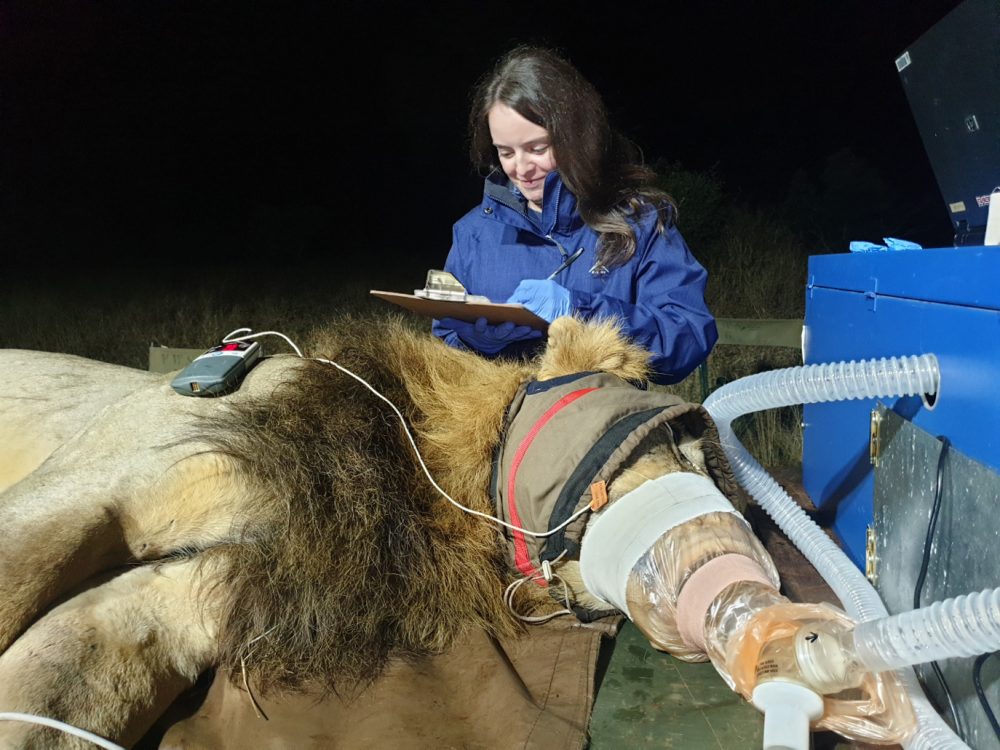
Ashleigh Donaldson monitors a lion for her PhD research project on novel anaesthetic protocols.
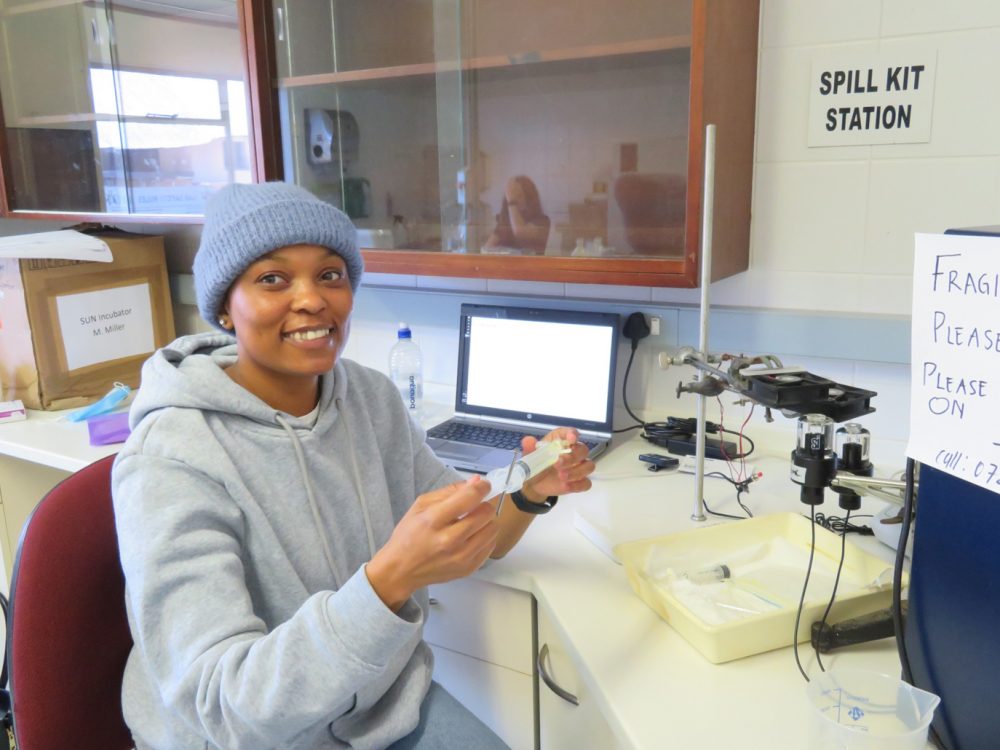
Thembeka Mtetwa, PhD student, analyses rhinoceros blood for oxygen content (Photos: Peter Buss and Brian Harvey).
Another infectious disease that is endemic in Kruger’s wildlife is bovine tuberculosis, caused by infection with Mycobacterium bovis. Investigations have shown that these bacteria can infect a wide variety of domestic and wild animal species, as well as humans. Although infection in the Kruger buffalo and lion populations have been known since the 1990’s, cases continue to be added to the current list of more than 15 affected species. In 2021, a publication in Emerging Infectious Diseases by The Animal TB Research Group from Stellenbosch University, in partnership with VWS and state veterinary staff, described the discovery of infection in two young bull elephants (Miller et al. 2021). The significance of this finding is that elephants and other species that share a habitat with Mycobacterium bovis maintenance hosts, such as African buffalo, may be at risk of becoming infected. Opportunistic surveillance also led to the finding of the first case of bovine TB in a wild hippopotamus from the Greater Kruger (Kerr et al. 2021).
Understanding how diseases are transmitted is a key to developing control strategies. It is hypothesised that KNP predators, such as lions and African wild dogs, become infected by eating prey with bovine TB; however, there has been little evidence to determine if they can spread it within a pride or pack. In 2021, researchers from the Animal TB Research Group were able to show that Mycobacterium bovis can be found in the respiratory secretions of wild dogs (Meiring et al. 2021). The significance is that translocation of infected individuals could present a threat of disease introduction to new populations.
To study the impact of diseases on individual and population health, there is a need to develop accurate rapid methods of identifying infected animals. This has been at the forefront of research collaborations between VWS and Stellenbosch University researchers. Advances in blood-based diagnostic tests, like those used for human TB, have included an optimised assay that can detect infection in lions, leopards, and cheetahs (Gumbo et al. 2021), which will facilitate epidemiological studies in these species. Ongoing surveillance for bovine TB in KNP rhinoceros and elephants also rely on tools being developed as part of these collaborations and will create a foundation for assessing the long-term effect on these populations.
A cornerstone of VWS research is evaluating novel approaches to improve techniques for the safe immobilisation of wildlife. In 2021, two large field projects were successfully implemented, including one that aims to evaluate the efficacy and safety of ketamine-medetomidine and ketamine-butorphanol-medetomidine for the immobilisation of lions, and the second that evaluates the effects of different drug combinations used to chemically capture white rhinoceros (Ceratotherium simum). Both projects will result in PhD degrees for students registered with the University of Pretoria Faculty of Veterinary Sciences. VWS staff are co-supervising the PhD candidates associated with these projects, which were made possible by the availability of animals, laboratories, and experienced veterinary staff to support the research.
SANParks’ continued investment in VWS resources, attracts new and ongoing research collaborations with South African and international institutions, which ultimately translates to improved and more humane protocols of working with wildlife as well as an understanding of wildlife disease.
This article was written by Peter Buss and Michele Miller and originally published in the 2021/2022 Research Report.
The article is based on publications in the journals Science (Jolles et al. 2021), Transboundary and Emerging Diseases (Kerr et al. 2022) and (Meiring et al. 2021) and Emerging Infectious Diseases (Miller et al. 2021)
Jolles, A., Gorsich, E., Gubbins, S., Beechler, B., Buss, P., Juleff, N., de Klerk-Lorist, L.M., Maree, F., Perez-Martin, E., van Schalkwyk, O.L. and Scott, K., 2021. Endemic persistence of a highly contagious pathogen: Foot-and-mouth disease in its wildlife host. Science, 374(6563), pp.104-109.
Kerr, T.J., Goosen, W.J., Gumbo, R., de Klerk‐Lorist, L.M., Pretorius, O., Buss, P.E., Kleynhans, L., Lyashchenko, K.P., Warren, R.M., van Helden, P.D. and Miller, M.A., 2022. Diagnosis of Mycobacterium bovis infection in free‐ranging common hippopotamus (Hippopotamus amphibius). Transboundary and Emerging Diseases, 69(2), pp.378-384.
Meiring, C., Higgitt, R., Goosen, W.J., van Schalkwyk, L., de Klerk‐Lorist, L.M., Buss, P., van Helden, P.D., Parsons, S.D., Möller, M. and Miller, M., 2021. Shedding of Mycobacterium bovis in respiratory secretions of free‐ranging wild dogs (Lycaon pictus): Implications for intraspecies transmission. Transboundary and Emerging Diseases, 68(4), pp.2581-2588.
Miller, M.A., Kerr, T.J., de Waal, C.R., Goosen, W.J., Streicher, E.M., Hausler, G., Rossouw, L., Manamela, T., van Schalkwyk, L., Kleynhans, L. and Warren, R., 2021. Mycobacterium bovis Infection in Free-Ranging African Elephants. Emerging Infectious Diseases, 27(3), p.990.