Tree mortality and the development of selection criteria for timber harvesting in the natural forests of the Garden Route, South Africa
A total of 2407 canopy trees of 17 species were monitored over a 22 year period in the Diepwalle indigenous forest dynamics research areas in the Garden Route National Park to assess species-specific mortality patterns and to develop and refine a set of criteria for the selection of harvest trees for timber species. Timber has been harvested from the Garden Route forests for more than 200 years. The project was an integral part of the development and implementation of the senility criteria harvesting (SCH) timber yield regulation system, whereby trees that are expected to die within the next 10 – 15 years may be harvested, with harvesting taking place on a 10-year cycle, thus ensuring sustainability.
The monitored trees were inspected every 5-6 years and possible visible indications of senility were assessed and described, including crown size, presence and severity of stem decay, structural damage, percentage crown dieback, incidence of epicormics shoots and increment (growth rate). Following the initial evaluation, a set of harvest tree selection criteria was developed for eight of the most common timber species. They were aligned with the 10-year species-specific mortality rates recorded in the research area during long-term forest dynamics monitoring. These criteria were then applied to select trees for harvesting in the scheduled harvesting areas. The selection criteria were refined, where appropriate, following re-evaluations.
The mean 10-year mortality rate for canopy trees of all species was 6.3%, with differences over time and between species. The most common mode of death is for trees to die standing. Most deaths occur in the smaller diameter classes that have the most trees, while several of the largest trees did not die during the evaluation period. The mean annual diameter increments (growth rates) for the period prior to commencement of the project were significantly lower for those trees that died during the 22 years monitoring period than for the trees that survived.
All of the monitored trees were assessed at each evaluation according to the different sets of criteria that had been developed. Trees meeting the criteria were recorded as “candidates” for harvesting. It was determined that the criteria used for identifying candidates for harvesting, i.e. the trees expected to die within the next 10 – 15 years, failed to identify many of the trees that subsequently died. They also identified many trees as candidates that survived the 22 year period. Some candidates even displayed apparent recovery to the extent that they no longer fell within criteria years later. The criteria were not considered sufficiently accurate for any of the species.
A new set of harvest tree selection criteria were developed and tested through detailed examination of the data. They represent an improvement on the criteria applied for more than 2 decades for the selection of trees for harvesting, but in many cases still do not accurately predict which trees will die within the following 15 – 20 years. Many trees die without showing obvious signs of their impending death, so it will not be possible to improve these criteria greatly in future. There are also various events that may have a temporary effect on the apparent tree condition, including seasonal effects, prolonged droughts, severe berg winds, mast fruiting events, etc. It is thus important that the harvest tree selection criteria are applied by experienced personnel that have an understanding and “feel” for local conditions and the natural forest dynamics, and should be applied more as guidelines than as rigid criteria, with some leeway allowed where necessary.
Reference
Durrheim, G.P. (2021) Tree mortality and the development of selection criteria for timber harvesting in the natural forests of the Garden Route, South Africa. Scientific Report 01 / 2021. South African National Parks, pp. 34.
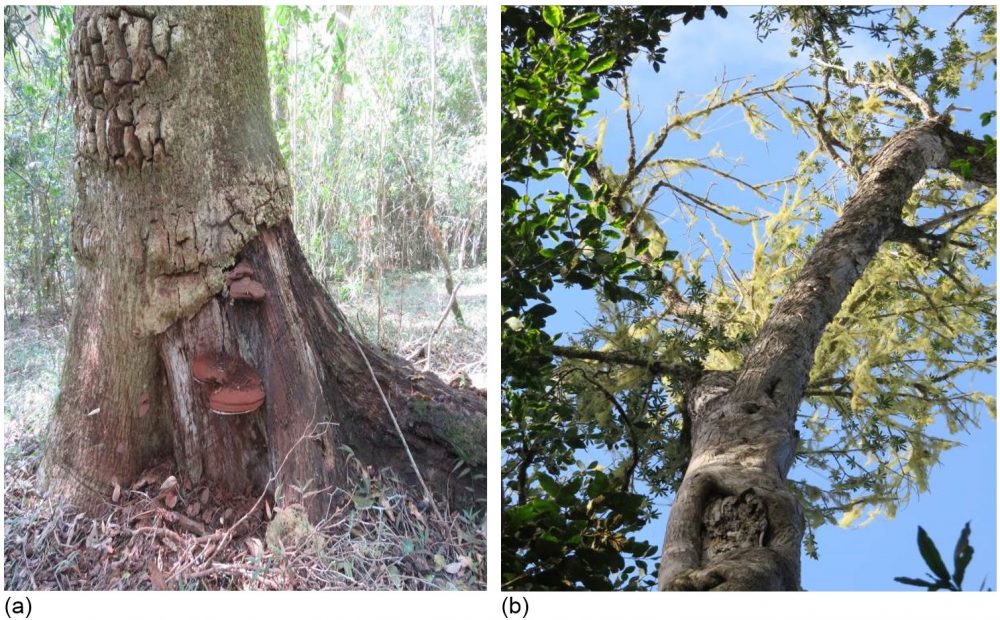
Assessing tree conditions associated with impending mortality: (a) Severe stem rot and the presence of Ganoderma bracket fungi are indicators that Olea capensis subsp. macrocarpa (Ironwood) may snap off at the base of the stem. (b) Podocarpus latifolius (Common Yellowwood) with a fork broken off, which is often not associated with the death of the tree, but also with severe stem rot at the base of the crown, where the stem is likely to snap off, killing the tree.
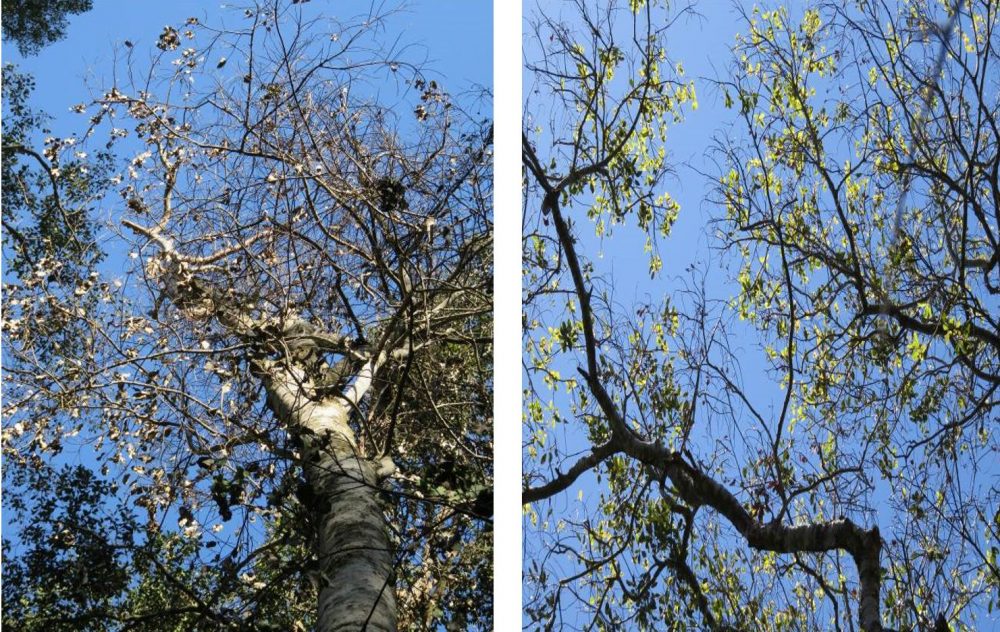
The condition of some trees may improve: Ocotea bullata (Stinkwood) trees may lose most or all of their leaves during prolonged droughts (left), but may produce new leaves and make a full recovery after sufficient rain has fallen (right).

Podocarpus falcatus (Outeniqua Yellowwood) can survive for hundreds of years to become the “Big Trees” of the Garden Route forests. Harvest tree selection criteria should thus be applied conservatively: (a) A fork broken off a Podocarpus falcatus is not expected to lead to the death of the tree, but (b) severe crown dieback is extremely rare and is probably an indicator of impending mortality.
