The rediscovery of Disa newdigateae in the Garden Route
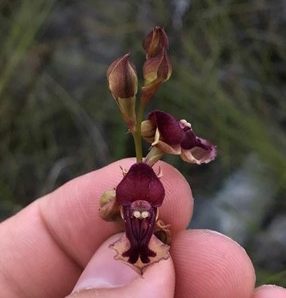
The flowers of the recently rediscovered Disa newdigateae. Special thanks to Ludwig Muller for bringing the discovery to SANParks’ attention and The Fynbos Five for their vigilance. Their passion for plants is a promising sign for the future of conservation and represents an important part of citizen science and community-based conservation.
The photo was supplied by CREW (Outramps)
Disa newdigateae was recently rediscovered in the Garden Route National Park, after it had been presumed to be extinct. Someone posted a picture of an unknown orchid on Facebook. Marthinus Vosloo, an orchid enthusiast, mountain explorer, all round nature lover and CREW (The Custodians of Rare and Endangered Wildflowers) volunteer, saw the post. He went to look for the plant, found it, and was the first to post the plant on iNaturalist in December 2018. Later, a group of young men who belong to a group called “The Fynbos Five”, Rendert Hoekstra, Ludwig Muller and Justin Ponder, also found the population and posted on iNaturalist in January 2022. These youngsters (who were all younger than 18 at the time of the discovery) are members of CREW and are actively involved in searching and conserving plants in the Garden Route.
Caroline Newdigate (1854 – 1937), then living close to Nature’s Valley, collected six specimens of what would become D. newdigateae, from March 1895 to April 1911. These were sent to the Bolus Herbarium where they were misidentified as Disa forficaria. Louisa Bolus correctly described the specimens as D. newdigateae in 1931 after examining fresh material of D. forficaria. Plants believed to be D. newdigateae were later found close to Kareedouw in the 1930’s and an undated (but old) specimen was found in the Riversdale area.
Disa newdigateae is a fynbos orchid, typically reed-like, up to 500 mm tall, with 300 mm long radical leaves. The inflorescence length is about 150 mm, with 9-16 maroon and greenish flowers. The species is believed to be pollinated by Chorothyse beetles due to the male beetle being attracted to the flower, which has a scent similar to that of a female Chorothyse beetle that is ready for mating. The beetle will visit the Disa flower, and in the process, pollination may take place.
The species’ current location, as well as originally recorded location have not burnt recently and old vegetation may pose a threat to its survival due to outshading reducing its reproduction capacity. The species is still Red Listed as Critically Endangered (Possibly extinct) until a new assessment is done. This is another plant species that has its only known location inside the Garden Route National Park.
This article was originally published in the 2021/2022 Research Report.
