The first population assessment for the endangered Knysna seahorse in two decades commences
Article Written by Clement Arendse & Ian Russell
In 2022/23 SANParks undertook a reassessment of the distribution and abundance of the endangered Knysna seahorse in the Knysna Estuary. The study entailed using SCUBA to undertake counts of seahorses along approximately 200 underwater transects, each typically 30 m long and 2m wide, positioned throughout the estuary, from the mouth northwards to just beyond the red bridge, above the N2 highway. This wide distribution of survey sites is similar to the approach used in previous surveys in the early 2000s, though with the noted inclusion of waterways in the Thesens Island Marina during 2022/23, which were under construction during the earlier survey period. The study allows assessment of how the seahorse population size and distribution has changed over time and is a crucial step in identifying areas of high abundance, both natural and artificial, that could potentially become high-priority areas for the protection of the Knysna seahorse in South Africa’s most biodiverse estuary.
The International Union for Conservation of Nature and Natural Resources (IUCN) describes the overall population trend of the Knysna seahorse as ‘Decreasing’, with habitat degradation and loss listed as some of the main drivers of change. Habitat degradation due to trampling, construction, boating activity, reduced water quality, and noise disturbance associated with leisure activities may negatively affect the Knysna seahorse population.
The surveying of seahorses in 2022/23 was a collaborative undertaking by SANParks and Oceans Alive Conservation Trust, with the dive teams consisting of two dive supervisors, up to ten divers, and two boat skippers. The divers recorded any vegetation found along the underwater transects, as well as the abundance of seahorses. When seahorses were found, they were gently captured, individually measured underwater, and released at the point of capture. Action cameras were used to video record surveys. Sixty transects were surveyed in the Thesens Island Marina.
Like a previous assessment of the Knysna seahorses in the marina in the mid-2010s, it was found that seahorses were more abundant in the western sections of the marina than the east. The first 250–300 m of the marina is of specific importance, measured from the western entrance at the SANParks office on the island. This assessment showed that the western section accounts for more than 60% of the seahorses found in the marina, with the first 250–300 m accounting for more than half that amount. The marina is an area of high abundance for this species when compared to much of the larger estuary. Researchers who have previously studied the Knysna seahorses in the marina have stated that the gabion baskets in the marina likely act as refuge areas, providing seahorses with holdfasts, protection and a suitable area to hunt for food.
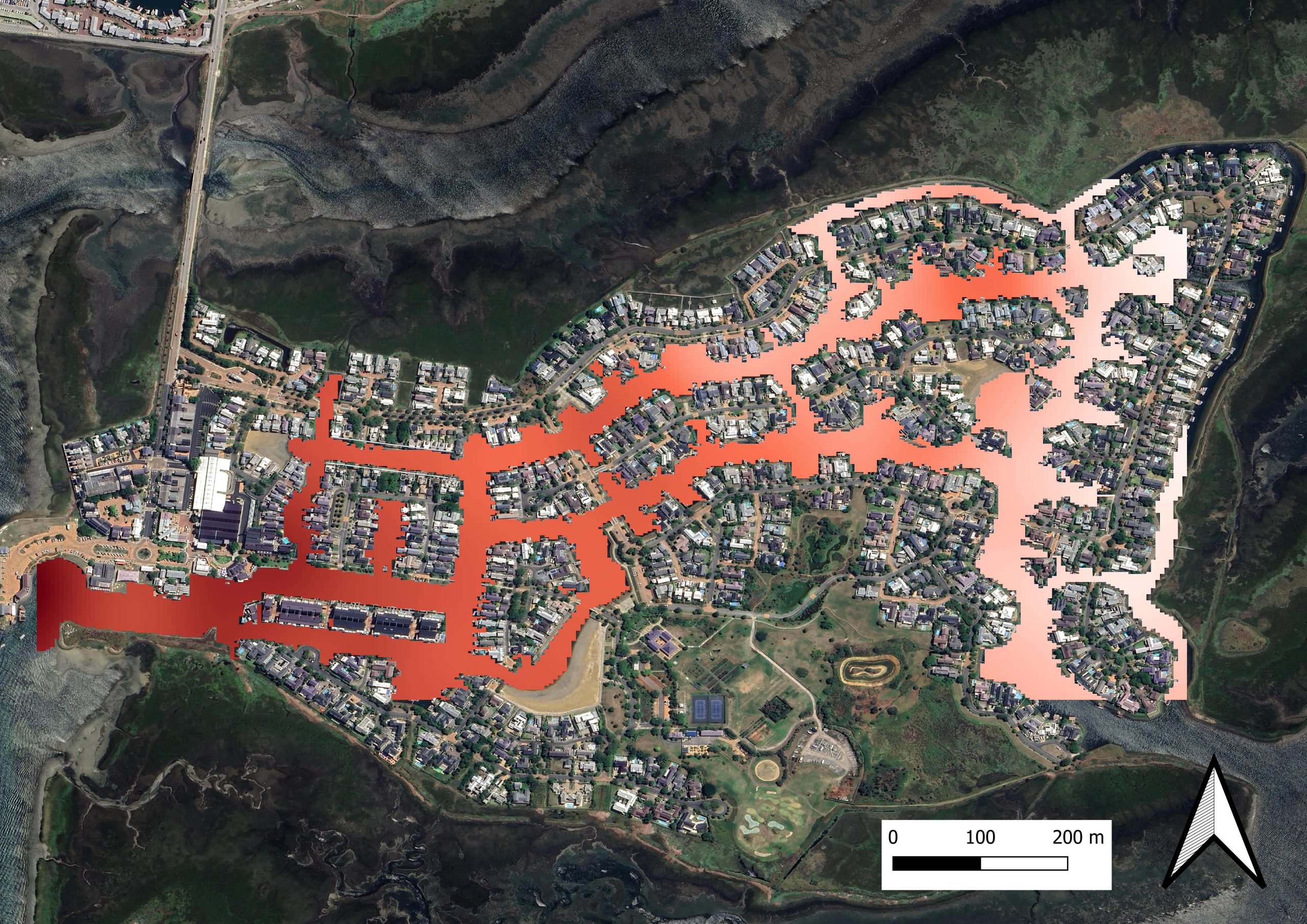
Heatmap of the Thesens Island marina showing Knysna seahorse distribution. Darker colours indicate a higher relative abundance of seahorses.
The surveys showed that the Knysna seahorse’s distribution in the larger estuary has contracted slightly over time, with most seahorses found along the main channel between Leisure Island and the N2 bridge. Areas of consistently higher Knysna seahorse abundance should logically be prioritised for conservation actions that prevent further habitat degradation. It is hoped that future surveys in Swartvlei and Keurbooms estuaries in 2024 will also reveal areas of high conservation importance in these systems and assist with identifying local management actions that will help ensure the survival of this iconic species in the Garden Route.
SANParks intends to continue with seahorse population assessments in September 2024, with the addition of surveys in the Swartvlei and Keurbooms Estuaries, thus making this the first complete population assessment for the Knysna seahorse in two decades.

Divers are searching for Knysna seahorses along a transect.

A diver measuring a Knysna seahorse during the 2022–2023 population assessment.

A diver releasing a Knysna seahorse found on one of the transects.

