South Africa’s oldest Flux Tower turns 25!
It is well-known that plants give us oxygen and transpire water, and the little organisms within our soils release carbon dioxide. We also know that these gases are also available from the atmosphere. But do we know much about how they move between the ground and the sky above it? Thanks to a quarter of a century worth of monitoring, we have learnt lots about how gases move between the earth’s surface and the atmosphere.

The Skukuza Flux Tower towering over the savanna landscape in southern Kruger National Park. © Tercia Strydom
While Kruger National Park is world-renowned for its charismatic wildlife and serene landscapes which offers the ultimate tourism experience, it is also well known for its rich history of scientific research which spans many decades. Due to the park’s involvement in pioneering African savanna research, Kruger is also home to South Africa’s oldest flux tower which turns 25 years old (Figure 1). From afar, it may be mistaken as a radio tower or broken wind pump missing some blades, but it is in fact a high-tech structure constantly monitoring a number of environmental and meteorological variables.
Flux towers are tall, elevated tower-like structures that are equipped with specialised equipment that monitor the vertical movement and exchange of gases, water, and energy between the atmosphere and the earth’s surface by applying a micrometeorological measurement technique known as Eddy Covariance. These unique instruments are able to collect high-frequency measurements (multiple readings per second) to observe fluxes in gases like CO2 and water vapour over long time scales. In addition, climate monitoring instruments are also installed on the tower to provide insights into how the climate is influencing the measured gas exchanges.
Kruger’s flux tower is one of about 17 eddy covariance flux towers (some of which are no longer functional) scattered across South Africa and was erected in 2000 thanks to a joint venture between the National Aeronautics and Space Administration (NASA) in the USA, the Council for Scientific and Industrial Research (CSIR) and SANParks. Over the years, the CSIR has done tremendous work in the maintenance and ownership of the flux tower. Until recently, an agreement between CSIR and SAEON has seen the Skukuza flux tower being co-managed by the CSIR and the Expanded Freshwater and Terrestrial Environmental Network (EFTEON) with support from SANParks. CSIR and EFTEON now visit Kruger monthly to service the flux tower and perform routine maintenance and calibration in order to ensure accurate measurements are being recorded (Figure 2). Such platforms, together with other supplementary measurements of the ecosystem, will provide insights into the carbon cycle, ecosystem productivity, and water and energy budgets – aiding a more quantitative understanding of our changing world.
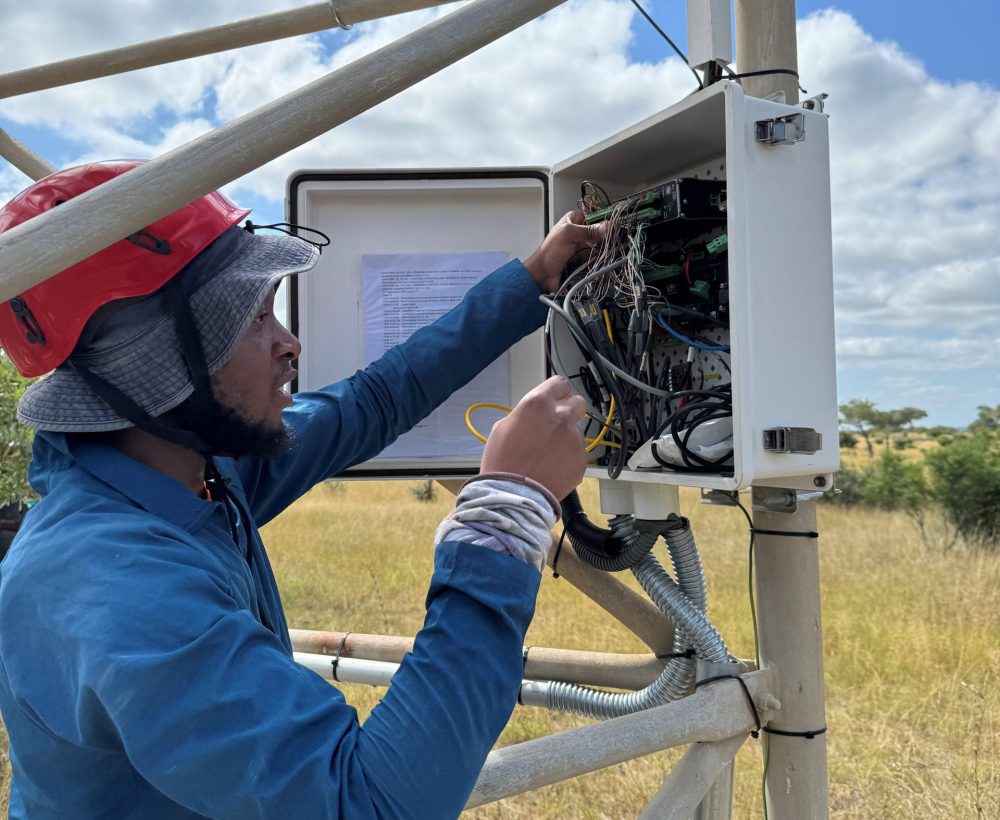
EFTEON Technician, Dr Amukelani Maluleke, during a maintenance check. © Tercia Strydom
Information about various atmospheric and climatic variables at the Skukuza flux tower can be viewed live at https://lognet.saeon.ac.za/SkukuzaEC/index.html


Dr Nolusindiso Ndara
EFTEON Landscape Scientist – Hydrology (Lowveld)Dr Amukelani Maluleke
EFTEON Instrument Technician (Lowveld)