Sharing SANParks’ knowledge with the world through scientific publications
Peer-reviewed journal publications remain an important metric for robust research and scientific credibility. Although a couple of colleagues had a particularly productive year, with six SANParks colleagues producing five or more papers in 2021/2022, it was a team effort with 38 colleagues producing a total of 64 papers (13 papers as principal author and 51 as co-authors – Appendix A). Science is supported and conducted by colleagues across positions and departments. Although the majority of authors are employed as scientists (n=19), the remaining in-house contributing authors are regional ecologists, biotechnicians, general managers, veterinarians, conservation managers and even SANParks top management. Fourteen of the authors, including two of the top five, are from racial groups previously marginalised from science and just over 50% of all the authors were female. An additional 57 papers were published by external researchers conducting research within the national parks or within broader social-ecological systems including parks.
SANParks authored papers were spread over a wide range of journal titles, including both local journals with a focus on Africa and South Africa (15 papers across 11 journals), as well as “international” journals where research is of wider interest or has implications for a broader audience (49 papers across 33 journals). Authorship across the papers highlighted, as in the past, the incredibly networked and collaborative manner in which science is conducted in SANParks, with more than 90% of the papers listing at least one non-SANParks author. This illustrates the intellectual and financial resources that SANParks leverages through pooling resources with scientists from outside of the organisation.
Although the total number of papers published by SANParks authors (64) is down from previous years (77 in 2019/2020 and 93 in 2020/2021), the quality remained very high (Fig. 1). All the published papers appeared in journals with a Clavariate Analytics Impact Factor, with a significant proportion of them in highly reputed journals. A particular highlight of this year was SANParks authors contributing to papers published in two of the most prestigious scientific journals. Corli Coetsee contributed to a paper led by Yong Zhou, a PhD student of Carla Staver at Yale University, which was published in Nature early in 2022. Yong used the long-term fire experiment in Kruger National Park to illustrate that although tree cover increased dramatically after six decades of fire suppression, the total amount of additional carbon storage per year is very limited as the soil carbon is not dramatically altered. This paper has practical implications of global significance as it quantitatively illustrates that fire-suppression schemes in fire-prone savanna systems will, over and above the biodiversity and functional damage and losses, be futile for carbon sequestration. In the other high profile paper, Peter Buss was a co-author on a paper in Science, led by Anna Jolles (Oregon State University), which explored why foot-and-mouth disease infections don’t disappear as herd immunity develops in buffalo. They found that inconspicuous, rare and sporadic transmissions ensure that the virus does not die out, and that this is further assisted by antigen shifts and seasonal births of susceptible calves. These two high-profile papers not only underline the value of the collaborative and collegiate approach to science within SANParks, but also highlight the global importance and impact of knowledge gained due to SANParks maintaining long-term experiments (e.g. fire experiments), providing specialised field support (e.g. veterinarian and aerial support) and having in-house expertise.
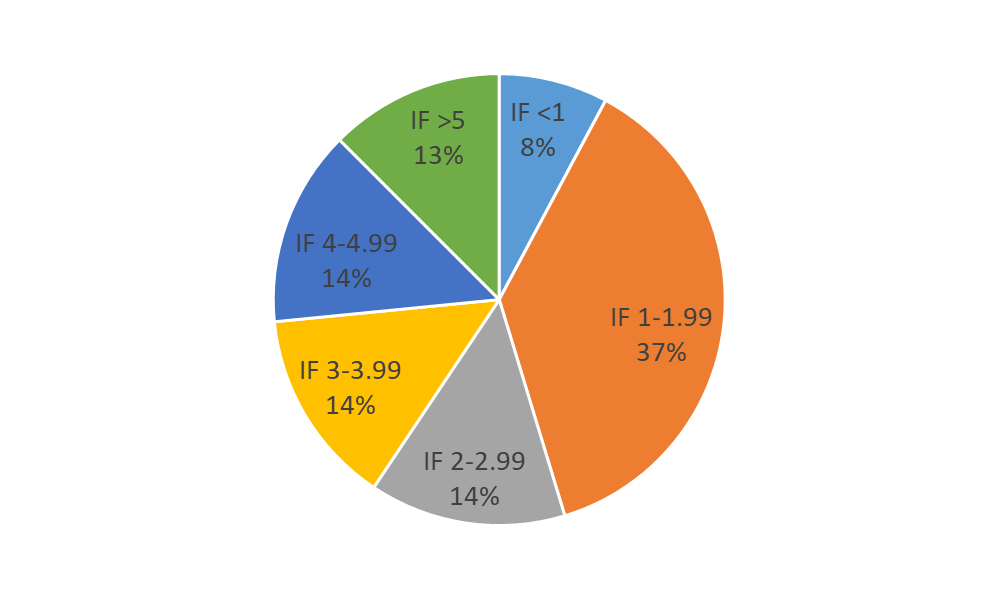
Figure 1. Impact factors (IF – Clavariate Analytics) for the 64 journal articles SANParks authors published in 2021/2022.
As in previous years, the total publication output is dominated by papers from the Kruger National Park with its long research history and well developed research support infrastructure (73 papers). Papers were also published on work conducted in twelve other national parks. Some papers were relevant across all parks, e.g. Avhavhudzani Phophe’s paper on the carbon footprint across all the national parks and Dirk Roux’s paper on strategic adaptive management as a process of organisational learning using the park management plan revision process as a case study.
Most of the studies were classified as contributing to the Ecosystem Pattern, Process and Function theme, which is one of the eleven priority research themes identified in the SANParks Research Strategy. Although Global Environmental Change, Technology Advancement (including testing new drug combinations for wildlife management) and Protected Area Effectiveness are three other themes that received reasonable attention, many of the other themes had very few or no papers over the past year (Fig. 2). These under-represented research themes present a growth opportunity for years to come, but should be approached in a way that does not detract from the research themes where SANParks is showing excellence. Growing research capacity in these under-represented themes will largely depend on SANParks staff building meaningful relationships with scientists with specialised skills and experience in these fields and making the parks attractive and creating enabling platforms for studying those themes in national parks.

Figure 2. For papers published during 2021/2022, the number of papers within the eleven research themes identified in the SANParks Research Strategy are shown. Where relevant, more than one theme was allocated to a paper.
Within SANParks, producing scientific papers is not the only and final goal, as knowledge needs to be communicated, contextualised and applied to inform conservation management within SANParks and beyond. Through the embedded science function, the knowledge reflected in these, and other publications over the years, will have the opportunity to make its way back into revised park management plans, advice provided to park management on appropriate interventions/approaches, inputs on various local and international policy documents and appropriate comments on Environmental Impact Assessments for developments within and around National Parks. SANParks also plays an active role in making this science available to the broader public, as evidenced by the 18 radio and television broadcasts, 20 popular press articles and 55 lectures and other presentations that Scientific Services were involved with in the past year.
We are proud to be part of this team that has consistently co-produced, communicated, dialogued and applied knowledge, for the betterment of conservation of our national heritage over many years.
This article was originally published in the 2021/2022 Research Report.


