Rapid recovery from an exceptional drought in Kruger National Park
Climatic extremes, such as severe drought, are expected to increase in frequency and magnitude with climate change. These events will likely have severe impacts on ecosystems and the people that rely on the services they provide, such as habitat for wildlife, tourism, and food production. Drought in grasslands and savannas causes most plant biomass to die back, leaving little food for herbivores. However, grasslands and savannas have a remarkable ability to recover after drought, this is what scientists call “resilience.” Understanding if and how ecosystems rebound after a natural disturbance is important to predict how they may fare under different climate scenarios.

Picture of experimental plot near Satara Rest Camp during the 2015/2016 drought in southern Africa. Fences are part of an experiment that examines the impact of fire and grazing in Kruger National Park savanna grasslands.
During the 2015 and 2016 growing seasons, an “exceptional” drought (less than 1 in a 100-year event) impacted much of Southern Africa. Our study site, the Experimental Burn Plots in the Kruger National Park, where the ecosystem-level effects of various fire regimes had been tested for the last 60+ years, was not immune (Figure 1). We used this experiment of annual, triannual, and unburned treatments to assess how these unique fire-adapted plant communities responded to the drought. Surprisingly, plant biomass recovered completely in all fire frequencies the year following the drought (Figure 2), indicating very high resilience of overall plant growth. Yet, the assortment and abundance of species present after the drought were substantially different from what was there before the drought.
In the annual and triennial burned sites, recovery was mostly due to a shallow-rooted, annual forb responding quickly to water availability in the early growing season. , so although total plant biomass recovered in these burned areas, the amount of forage available for wildlife was greatly reduced. In unburned sites, however, recovery of plant biomass was due to non-dominant grass species compensating for the mortality of more common grasses. In contrast to the burned sites, these compensating grasses were highly palatable for grazers. This was possible because of the higher diversity of grass species (and their seeds) in unburned sites compared to burnt sites.
Overall, the full recovery of plant biomass one year after the most severe drought on record in Kruger National Park shows the remarkable ability of these ecosystems to recover. However, the low palatability of plant species and lower biodiversity after drought in some burn regimes suggest that fire is an important management tool that can enhance, or impair, the full functionality of savannas as droughts become more frequent.
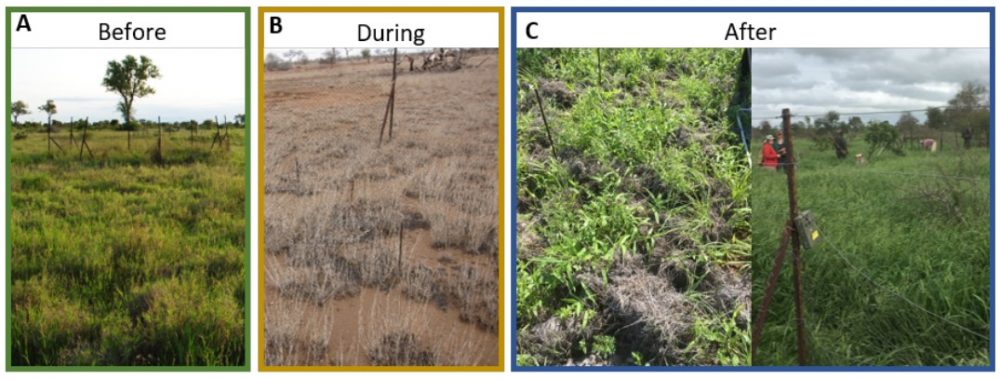
Before, during and after the drought in Satara
Paper reference
Wilcox, K.R., Koerner, S.E., Hoover, D.L., Borkenhagen, A.K., Burkepile, D.E., Collins, S.L., Hoffman, A.M., Kirkman, K.P., Knapp, A.K., Strydom, T. and Thompson, D.I., 2020. Rapid recovery of ecosystem function following extreme drought in a South African savanna grassland. Ecology, 101(4), p.e02983. https://doi.org/10.1002/ecy.2983


Kevin Wilcox
University of WyomingDave Thompson
SAEON (Ndlovu Node)