Putting marine biodiversity data management on the agenda
On Wednesday the 18th of October, CapeNature, the Department of Forestry, Fisheries and the Environment (DFFE), the South African Institute for Aquatic Biodiversity (SAIAB), South African Environmental Observation Network (SAEON) and SANParks colleagues met to discuss the management of marine biodiversity data. This workshop was pivotal to some of the workshop participants for numerous reasons. SANParks has historically had a much stronger focus on the terrestrial environment than the marine environment, and marine protected areas (MPAs) continue to be under-studied, understaffed and under-prioritised compared to national parks. Additionally, although data management is fundamental to conservation science and management, it is not a priority and is often neglected.
Evidence is needed to demonstrate the benefits of MPAs especially as further protection of marine resources is required while there is stakeholder conflict with the users of marine resources.
It was clear from the workshop that SANParks is far behind other South African institutions that have data management as a central component of their mandate. SAEON and SAIAB have impressive data infrastructure, including data storage and backup, and technical human capacity in comparison to SANParks. Basic data management infrastructure, such as large portable hard drives, Network Attached Storage and Lexar professional workflow hubs are missing in SANParks. It was also mentioned that SANParks has a gap in the lack of offshore monitoring that is being conducted in Addo Elephant National Park MPA.
Many interesting discussions were had. The participants mentioned how important the meeting topic was and that there is a need for a marine biodiversity data management network to continue the conversation and make more progress in this area.
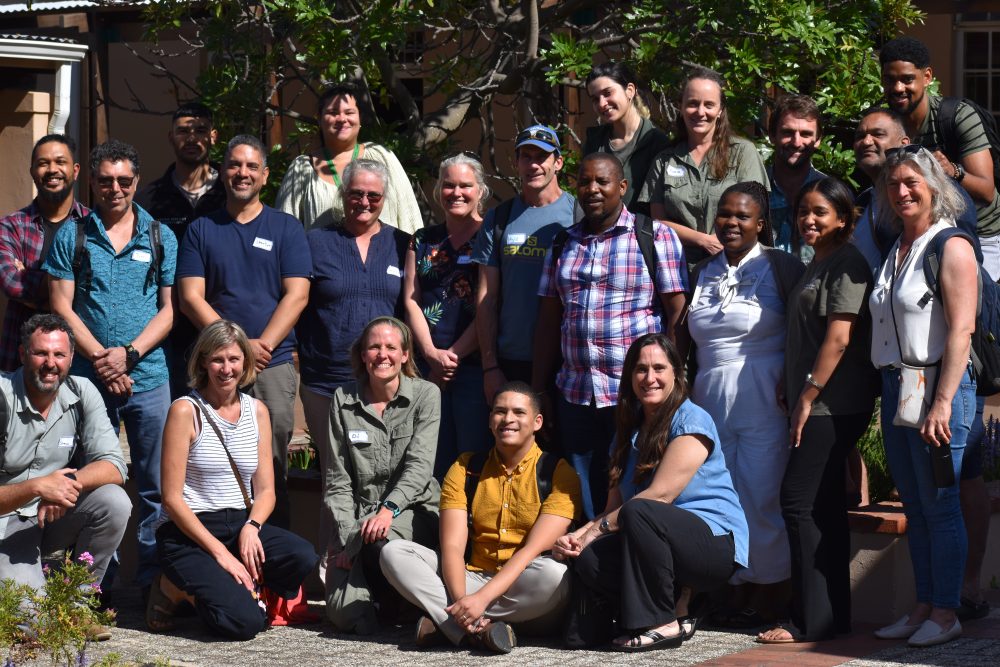
Some of the participants of the marine biodiversity data workshop at the Cape Research Centre.
How best can we demonstrate the benefits of MPAs?
It was clear from discussions at the workshop that it is fundamental to collect population size data for fish species that MPAs are intended to protect. i.e., fish lengths for as many fish as possible need to be extracted from Baited Remote Underwater Video (BRUV) data from inside and outside of protected areas. If MPAs are protecting fish species, then the populations should have high frequencies of larger individuals. Morphology is included as one of the Essential Biodiversity Variables encouraged by the GEO BON (Group on Earth Observations Biodiversity Observation Network).
What resources are available for us to use?
At the workshop we learned about useful databases, tools and initiatives:
- DFFE’s Marine Information Management System provides functionality to upload raw or processed environmental and biodiversity data and obtain a DOI for that data, which will be archived. The system is compatible with Darwin core metadata and WoRMS names. Data from MIMS is shared with AfrOBIS.
- OBIS (Ocean Biodiversity Information System) is a global open-access data and information clearing-house on marine biodiversity for science, conservation and sustainable development. The names on OBIS are from the WoRMS (World Register of Marine Species).
- Global Archive provides a secure data repository of annotation of marine and freshwater fauna with a focus on stereo techniques and easy import of data tables generated by EventMeasure software as well as the import of count and length data in different formats. Global Archive uses names from WoRMS.
- The Global Ocean Observing System (GOOS) is a global initiative that provides information and tools to help coordinate and monitor global ocean observation of oceans resources and sea conditions. GOOS provides forecasts of sea conditions and data that can be used in climate change assessments.
- The Shallow Marine and Coastal Research Infrastructure (SMCRI) collects and provides environmental observation data through the South African Estuaries Information System (SAEIS), Observations Database (ObsDB) and SAEON Open Data Catalogue.
- SAEON’s SeaMap project, which is funded by the Foundational Biodiversity Information Programme (FBIP), will have 51000 marine occurrence records by the end of 2024.
- SAIAB has internal animal tracking database.
- There is national demersal trawl monitoring data available.
- Some organisations are using Specify for storing some of their data, although it was recognised that this software is designed for collection data and has limitations. e.g. Global Archive is a much better place to store BRUV data.
- Survey 123 was mentioned as an App that can be used to collect field data.
How can we work together?
The importance of interoperability was discussed at the workshop. It is crucial to use standard approaches to collect, store, and share biodiversity and environmental observations. As far as possible we should all be following global best practices for data collection, collation and storage. This includes using global best practice guidelines for collecting BRUV data and using Darwin Core archive for storing data. Using standardised approaches allows for data comparison and sharing. Another way we can work together is by sharing data on accessible platforms, such as Global Archive and GBIF. We can also work together through forums such as this, sharing best practice and developing a network.
SAIAB has already put substantial effort into developing guidelines to support their own work, and they already share guidance and advice, including protocols towards standardisation. SAEON has also already shared protocols and guidelines with SANParks. SAEON also suggested that SANParks forming partnerships with universities to be able to use university internet for uploading large volumes of data to the SANParks cloud storage as SANParks has such bad network speeds. SAIAB offered to loan SANParks portable hard drives. DFFE offered assistance with hosting data. These kinds of suggestions and offers of support indicate the importance of having forums like this and sharing our challenges and information on what we are all doing.