Understanding Wildlife in Kruger National Park: Methods used to count animals (Part 1)
Kruger National Park in South Africa is famous for its wildlife and is a key part of the country’s natural heritage. Managing wildlife is important to protect biodiversity while also supporting the economy. In most years, the South African National Parks (SANParks) conducts surveys to count animals in Kruger. These surveys help park managers make decisions about conservation and animal management.
SANParks counted the animal populations in Kruger in 2023. These include all the big mammals and crocodiles. This blog will share the main findings. It will also explain why these animal counts are important for Kruger’s future.
Why Animal Surveys Are Important
Wildlife surveys help track the numbers and health of different species. In Kruger, large animals like elephants, rhinos, and buffalo play an important keystone role in the ecosystem. They also attract tourists. Knowing how many animals there are, and their distribution helps managers plan how to protect them. It also helps align animal numbers with the environment.
SANParks follows two main goals:
- Protecting ecosystems and wildlife.
- Using natural resources in a way that supports the economy without harming nature.
When the number of animals increases, especially if this happens in localised areas, the environment may be harmed, or it may cause problems with people. In these cases, some animals are moved or taken out of the park. For example, the crowding of hippos in a pool of water may result in water with high faecal loads, making it unsafe for other animals to drink. Removals are done with care to make sure all species stay healthy and maintain their ecological role in nature over time.
Survey Methods
The methods that SANParks use to count animals has changed over time as technology and better information has become available. Survey methods are also selected based on how animals behave and where they occur in the park.
View/Download Infographic: Animal numbers for Kruger National Park and background on animal counts
In 2023, the following types of aerial surveys were used:
- Fixed-Wing Aircraft Surveys: To count animals like impala, zebra, kudu, giraffe, and wildebeest. A small airplane flies in straight lines, while people on board count the animals below in marked strips.
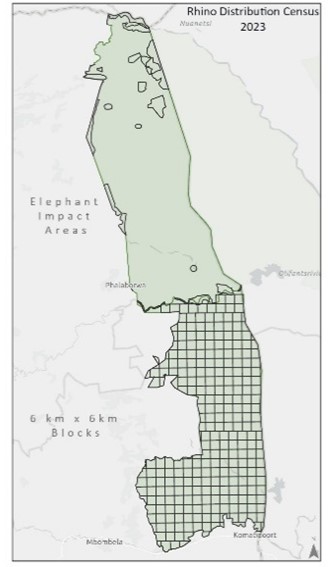
- Helicopter Surveys: To count elephants, buffalo, rhinos, and rare antelope like sable and roan. Helicopters fly lower and slower than aeroplanes and can hover safely over larger herds of animals which makes counting them a little easier.
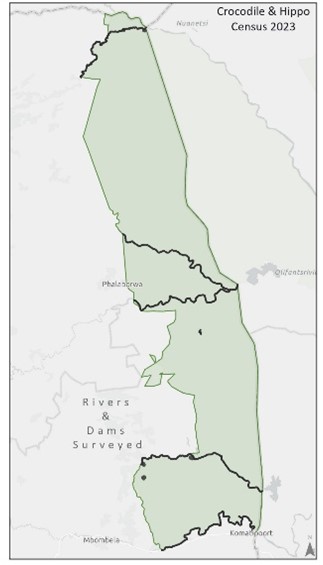
- River Surveys: Helicopters fly along rivers and around dams while observers count crocodiles and hippos in the water.
| Plains game | Buffalo, elephants, rare antelope, and rhino | Crocodile and hippopotamus | |
| Type of aircraft | Fixed wing- Cessna 206 | Helicopter (2x) | Helicopter |
| Observers | 1x Pilot
1x Data recorder 4x Observers |
1x Pilot
1x Data recorder 2x Observers |
1x Pilot
1x Data recorder 2x Observers |
| Area surveyed | 27% total area coverage | 100% area coverage of Southern Kruger | 8x Large seasonal and perennial rivers and selected dams |
| Protocol
(Height and airspeed) |
250ft (76.2m)
90-100 knots |
147.6ft (45m)
65 knots |
350ft (106.7m)
50 knots |
| Flight plan | 109 East-West transects. 3km apart north of the Olifants river and 3.75kms apart south of the Olifants river.
400m strip on each side of aircraft (A,B,C and D- each 100m wide). |
6x6km blocks with strip transects flown 400 m apart within each block. The observers call animals within 200m of the aircraft.
|
Fly along rivers and relevant dams.
|
| Species recorded | Impala, Kudu, Giraffe, Warthog, Waterbuck, Wildebeest, and Zebra | Buffalo, Elephant, Rhino, Eland, Roan, Sable, Tsessebe, Lichtenstein’s Hartebeest, Common and Mountain Reedbuck | Crocodile, Hippopotamus,
Water birds such as Fish Eagle, Saddle-billed Stork, and Goliath Herons |
| Recording observations | Species common name, number of animals visible, strip letter, e.g., Impala, 30, B
Recorded on Cybertracker. |
Similar method as with the fixed wing. Photographs were taken of larger herds of animals and demographics were recorded when possible. Rhinos were recorded according to the sex, age and notch (where applicable).
Recorded on Cybertracker. |
Crocodiles are called according to the number visible and their size class (small- very large). Hippos and birds are called according to the number visible.
Recorded on ArcGIS Quick Capture. |
| Maps | 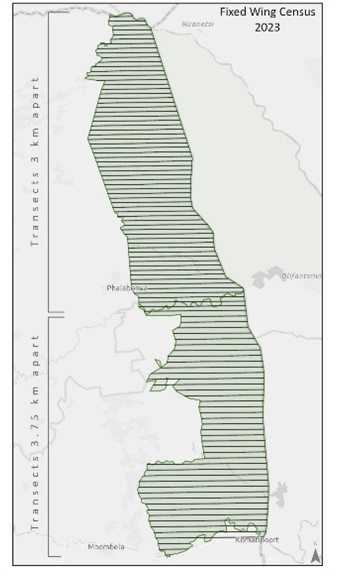 |
 |
 |


Erin Crowhurst