Marking trees for timber harvesting in the Garden Route National Park
The sustainable harvesting of timber from the indigenous forests of the Garden Route National Park has resumed to supply the local furniture industry.
Following recommendations of a feasibility study, a pilot project was launched in 2021 to resume sustainable harvesting of timber from the indigenous forests of the Garden Route National Park in accordance with SANParks’ Resource Use Policy. Timber has been harvested from the indigenous forests of the Garden Route since at least the 1770’s. More than 200 years later, there is still demand for timber of several species, mainly for the manufacture of high-quality furniture and ornaments by the local furniture industry.
An experienced Scientific Services team searched through selected forest areas close to roads and permanent slipping paths to select the trees that could be harvested. Trees with utilisable timber were selected for harvesting if they met species-specific selection criteria based on visible signs of senility, declining vigour and low future life expectancy. The criteria are calibrated to natural senility patterns as determined by long-term research.
A total of 275 indigenous trees of 15 species (approximately 209 m³ of timber) were marked for harvesting, as well as about 267 Australian Blackwood (Acacia melanoxylon) trees (approximately 300 m³). Some of the Blackwood timber was marked in the scheduled timber utilisation areas, but most was available in other areas as part of alien invader plant control operations.
The trees were sold “standing” (i.e. unfelled) on an online auction, with four buyers bidding a total of R338,450 for the timber. All of the buyers are established timber merchants or fine furniture manufacturers from the Western and Eastern Cape. Only 49 trees (20 m³), mainly smaller and poorer quality Blackwood, were not sold. The buyers will harvest the trees, using approved skilled contractors with appropriate equipment, while SANParks ensures compliance with strict harvesting standards and guidelines.
Programmes like this illustrate how national parks can benefit humans in ways other than those typically associated with leisure and tourism activities. Through carefully planned and closely monitored initiatives like this, SANParks supports the local economy and artisanship, which is part of the Garden Route’s cultural heritage, without compromising the integrity or the resources from the forests.
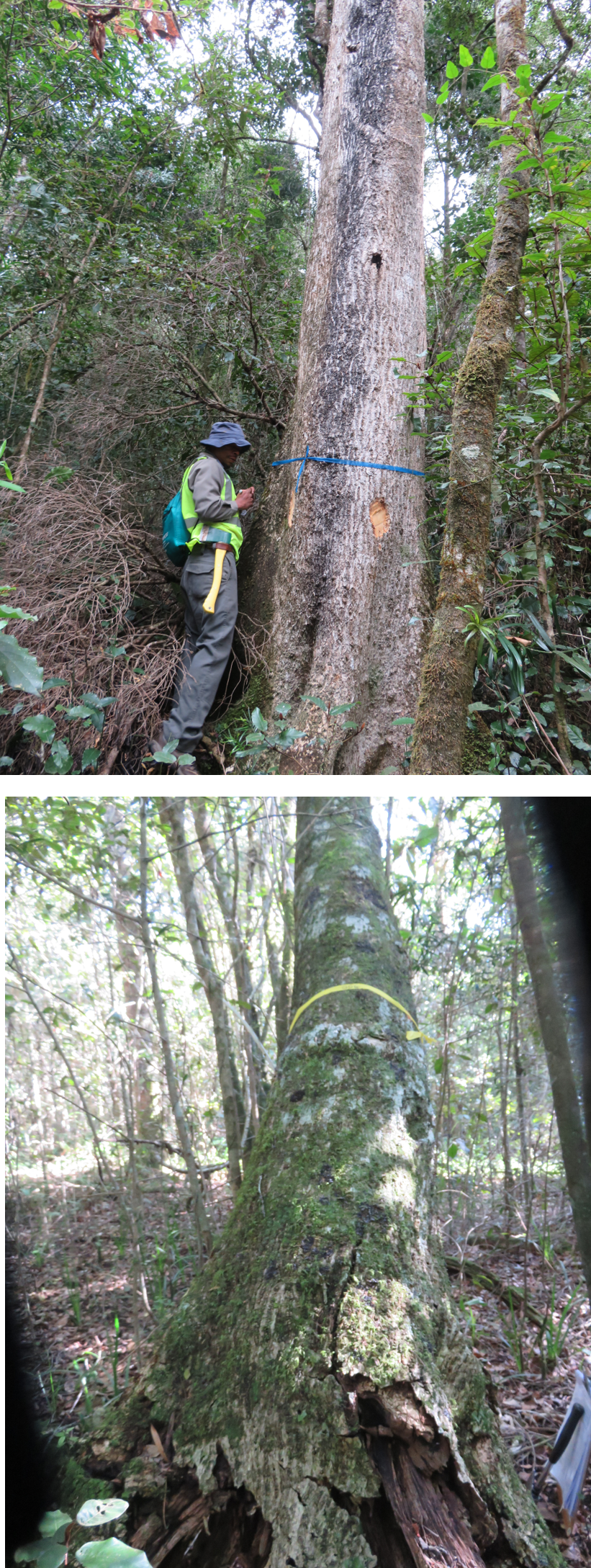
Top: Ironwood (Olea capensis subsp. macrocarpa) with dieback in the crown is marked for the timber auction. The blue tape indicates that the large branches in the crown must first be cut off before the tree may be felled, a process known as topping, to limit damage to the surrounding forest. Bottom: Another Ironwood with severe basal rot marked for the timber auction. The yellow tape indicates that the tree may be felled without topping (Photos: Graham Durrheim).
This article was originally published in the 2021/2022 Research Report.
