Levelling Up Monitoring Efforts Towards Saving Our Iconic African Penguin
South Africa’s iconic African penguin population is in serious trouble.
Once abundant in colonies along the west coast and Namibia, penguin numbers have been rapidly dwindling over the past century. Historically, this was due to extensive guano and egg harvesting, however recent declines have been attributed mainly to a shortage of food around their colonies. Penguins’ preferred prey are sardine and anchovy whose stocks have also been diminishing due to a shift in their distribution coupled with continuous fishing, forcing penguins to swim even further to feed themselves and their chicks. SANParks is the custodian of ~55% of the remaining African penguin population, located mainly on St Croix and Bird Islands in the Addo Elephant National Park marine protected area (MPA). Recent estimates have shown an alarming drop in abundance of penguins at these colonies. This has been linked to increasing shipping following the introduction of ship-to-ship bunkering operations in Algoa Bay. With the rising frequency in larger vessels entering the bay, more noise, disturbance, displacement and pollution including from oil spills have been observed.
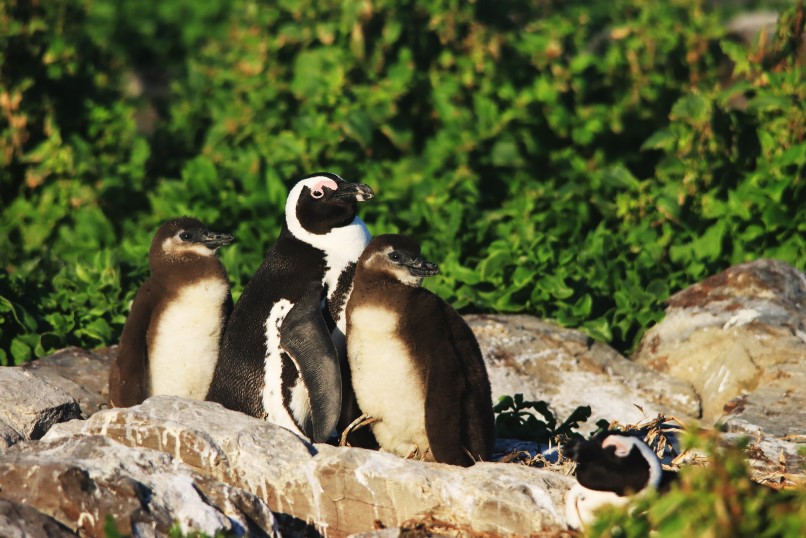
Photo taken by Eduard Drost
To address these and ongoing concerns for African penguins, several management measures as part of the National Biodiversity Management Plan for Penguins, administered by the Department of Environment, Forestry and Fisheries (DFFE), are being implemented to increase protection and support successful breeding. These include the placement of artificial nest structures in colonies to provide better protection for breeding adults and chicks from predators and extreme weather conditions. In addition, problematic predators such as seals and gulls are deterred from colonies. Injured and weak birds are taken into rehabilitation and released once they are strong and healthy again. SANParks has also escalated its monitoring and compliance efforts particularly on Bird Island with the appointment of seven seabird monitors. Their main role is to increase monitoring and rehabilitation efforts on the island, as well as assist with law enforcement and maintenance. These passionate “seabird warriors” bring unique skills and talents to the team and share their experiences on the island with us.

This is Dalumzi Gladile. Hailing from Idutywa, in the Eastern Cape, he holds a national diploma in marine science from Cape Peninsula University of Technology. With work experience in marine conservation, data collection and law enforcement, he enrolled in the Groen Sebenza internship program where his duties involved marine ecological monitoring and environmental education. As a seabird monitor, he gets to travel to Bird Island, for three weeks at a time, to perform exciting observational and rehabilitation duties around African penguins and Cape gannets. “I have an amazing team that makes my job even easier,” he says. Dali aims to use this exceptional opportunity to grow professionally and personally within the conservation industry.

Megan Jackson is a curious individual with a deep love of nature and wildlife, a fascination for island ecology and a passion for protecting biodiversity for future generations. She recently finished her MSc at Stellenbosch University which looked at the population genetics and morphology of South Africa’s most prolific seagrass, Zostera capensis. Megan enjoys working on Bird Island, including assisting with the stabilisation of injured seabirds until they can be taken into rehabilitation. She is always keen to assist SANParks’ and external scientists with data collection. She says, “it’s amazing to observe the penguins during breeding season and watch them grow from tiny brown fluff balls into blues. The chicks are super cute – from a distance, because the parents are very feisty and protective of their young!” Megan notes that one thing that is sad about working on the island, is seeing how much plastic litter washes up from the ocean every day and encourages everyone to please recycle!

Wendy Olivier worked as a marine Environmental Monitor (EM) at Table Mountain National Park. Her passion for nature was ignited while working at the Boulders penguin colony. Determined to grow herself and her career, she took up a role as an EM in the Marine Unit of SANParks where her duties included anti-poaching operations on land and at sea providing her with first hand education on marine by-laws. She has also worked with DFFE leading to her being deployed on the vessels, Ruth First and Sarah Baartman, gaining invaluable experience whilst building relationships with other enforcement agencies. She extends her passion to her work on Bird Island where she undertakes data collection related to seabirds, observations and minor law enforcement. “I am truly grateful for where I’ve been and what I’ve accomplished in my career prompting me to pursue further opportunities in conservation,” says Wendy. “I feel there’s so much more I can do, and I’m hopeful that moving forward I will accomplish more.”

Bianca Jooste, hails from the beautiful Kylemore in Stellenbosch. She loves being outdoors and spending time near the ocean, whether swimming, snorkelling or just observing. One of her goals is to become a certified SCUBA diver and skipper. Bianca is passionate about the marine environment which shows in her studies of marine science and oceanography. She has worked at DFFE, Iziko Museum and volunteered at Helderberg Nature Reserve. A highlight in her career to date has been the opportunity to assist with phytoplankton sampling in the Southern Ocean. She remembers the hours being long and the temperatures freezing cold, while remaining in absolute awe of the surrounding beauty and brilliant minds she had the opportunity to work amongst. Monitoring and rehabilitation of endangered seabirds are part of her responsibilities on Bird Island, along with assisting researchers with other projects. Bianca shares, “I absolutely love spending time on the island and learning about these birds. During my experience at SANParks, I have become more independent, gained much knowledge about general maintenance and continue to learn about the marine environment.”

Peter Bartlett is a seasoned seabird monitor having worked in monitoring and management of seabird colonies for almost 40 years. Originally from East London, Peter embarked on five subantarctic research expeditions to Marion Island, and three to Prince Edward Island where he assisted with seabird, killer whale and fur seal monitoring. In the early 1990s, he took up a position on Ichaboe Island Nature Reserve in Namibia as the island headman. Here his responsibilities included monitoring and mapping of seabird populations to assess seasonal variation in numbers of birds using island areas for breeding and roosting, along with predator management and rehabilitation. Peter is highly skilled in building maintenance and upkeep along with a gift to fix almost any appliance or piece of equipment.

Sanele Mkhonza has worked in biosecurity, as well as marine law-enforcement that included small scale fisheries permitting. He spent a year as an Environmental Control Officer and seabird monitor on Marion Island. His current role as a seabird monitor on Bird Island entails playing a part in rehabilitation, collecting data on natural and artificial nests to determine breeding success – important efforts towards maintaining or restoring population numbers to save the last remaining colonies of African penguins. Sanele values being part of the team responsible for maintaining the foundations of seabird research through continuing important long-term monitoring and enjoys working with people from different academic and professional backgrounds. He would like to be a positive influence and leave a mark along the landscapes and organisations he’s been a part of.

Thando Cebekhulu holds a BSc Honours in Zoology from the University of the Free State, and seven years’ work experience – more than five years working with seabirds. His work on Bird Island includes bird ringing, breeding seabird censuses and digital data capture amongst other responsibilities. Thando says, “the highlight of my career was working on Marion Island, which is one of the sub-Antarctic islands teeming with animal life.” He enjoys playing and watching sport especially cricket, rugby and soccer, and has some culinary ambitions he’d like to pursue.
Having exceptionally passionate and skilled people has substantially strengthened the eyes and ears within the colonies, while the increased capacity has greatly enhanced rescue and rehabilitation efforts. However, it will take much more awareness and involvement not just from our seabirds monitors and managers but from all South Africans to engage in processes where necessary to implement appropriate protection measures to help save the African penguin.

