Is passive rehabilitation enough to restore fynbos in the Garden Route?
By examining the recovery of fynbos in clear-felled pine plantations, the study observed that fynbos could be re-establish through natural regeneration, however, the potential for recovery decreased with the duration under plantation. Secondary invasion by nitrogen-fixing Acacias is a further barrier to the recovery of fynbos because of soil enrichment.
Restoration has become an integral part of conservation for its potential to reverse degradation, reduce biodiversity loss and recover ecosystem function. Restoration is especially important for the Garden Route National Park (GRNP) because the park is an amalgamation of land parcels, and some land parcels were not managed in line with biodiversity conservation objectives before incorporation into the park.
The most recent land parcels incorporated into the park are the plantation “exit areas”. These are decommissioned state plantations previously used for commercial tree farming, which were clear-felled of pines for rehabilitation back to fynbos, which is the natural vegetation type. Currently, rehabilitation in the park only involves removing aliens and allowing for natural regeneration to occur.
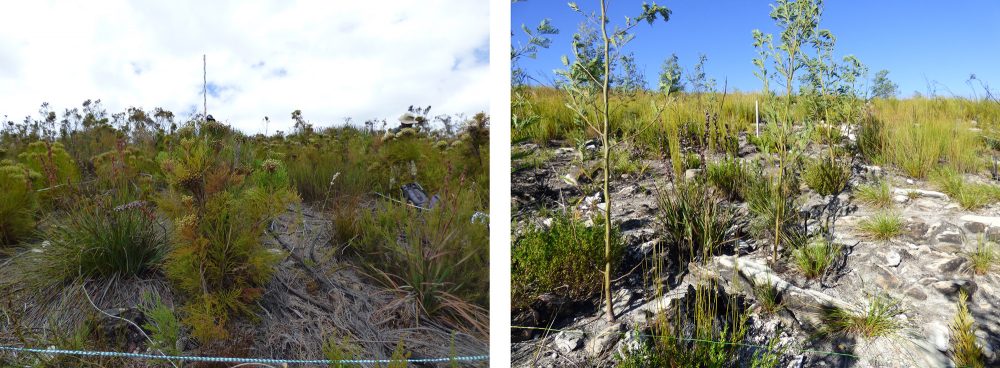
Left: Recovery of site C5a two years after clear-felling. Right: Same site two years after a fire. This shows an emerging trend at the monitoring sites where secondary invasions, mostly by Acacia melanoxylon and Acacia mearnsii, have occurred only once a fire has occurred at these sites.
However, research has shown that the regeneration of indigenous vegetation in previously disturbed areas depends on past activities and ecosystem dynamics. Planting trees in a treeless system results in abiotic and biotic changes that deteriorate the previous vegetation’s ability to self-repair. This is because pine plantations form dense stands for years, often at the total exclusion of fynbos and natural ecological processes. Over time, this leads to the degradation of the soil-stored seed bank, resulting in an impaired ability to recover and reduced resilience.
Monitoring is thus a crucial part of the restoration process because it can flag sites that are not recovering to fynbos, allowing management to optimally allocate scarce resources.
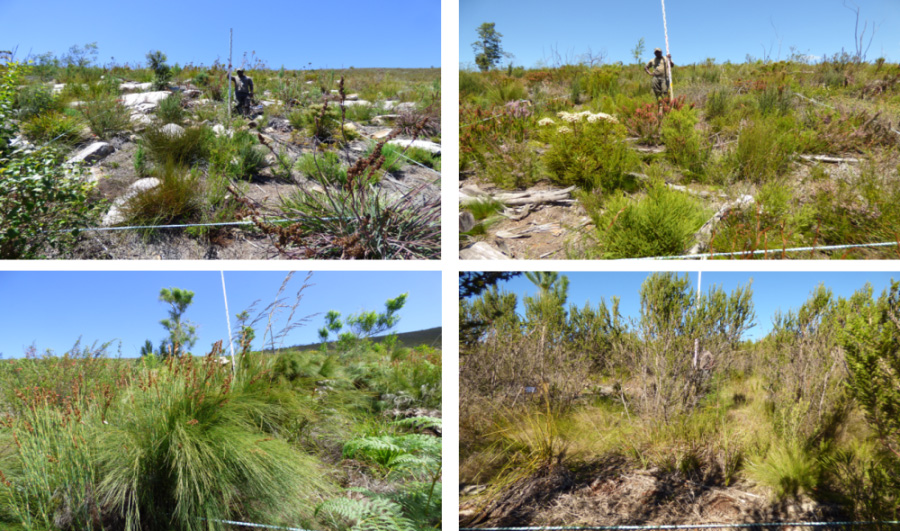
Fynbos sites at varying years of recovery after clear-felling of pine plantation. Top left: Site C5b two years after clear-felling (two rotations of Pinus pinaster). Top right: Site C8 three years after clearing (two rotations of P pinaster). Bottom left: Site C5a four years after clear-felling (three rotations of P radiata). Bottom right: Site C6a five years after clear-felling (three rotation of P radiata). The longer the site had pine, the slower the recovery (Photos: Thabang Sibiya).
We sampled four sites at varying times after clear-felling, which varied in the number of planting rotations to show recovery over time. Findings indicate that fynbos is still able to recover from the natural seed bank: natural vegetation cover increased with the age of the site. However, the vegetation’s ability to self-repair declined with the number of planting rotations over time. Sites that had two planting rotations, of approximately 60 years, had better recovery of native species richness and abundance compared to the sites with three planting rotations.
With the baseline data established, the next phase is monitoring the role of fire in the restoration of fynbos vegetation. An emerging trend is increased invasion by blackwood (Acacia melanoxylon) and black wattle (Acacia mearnsii), in those sites that have experienced fire.
Reseeding and replanting could be considered in sites with three rotations to encourage native species recovery and ecological resilience. Given that these sites had reduced recovery, they may be particularly sensitive to perturbations, such as invasion with aliens, and clearing of aliens should be prioritised to support recovery.
This article was originally published in the 2021/2022 Research Report.