Invasive plants are more phytochemically diverse than native counterparts
Invasive species are spreading at an accelerated rate due to globalization. A better understanding of the chemical advantages these species have will assist in determining the invasiveness of a species and thereby optimize management practices by potentially determining which species have high likelihood of invasion. Our research aimed to help provide information to control the spread of invasive species, by investigating the reason for why they are so proliferative. We chose three species native to the US that are labeled invasive and pose severe ecological threats in South Africa’s largest protected area, Kruger National Park (KNP). These plants are Chromolaena odorata, Datura stramonium, and Xanthium strumarium.
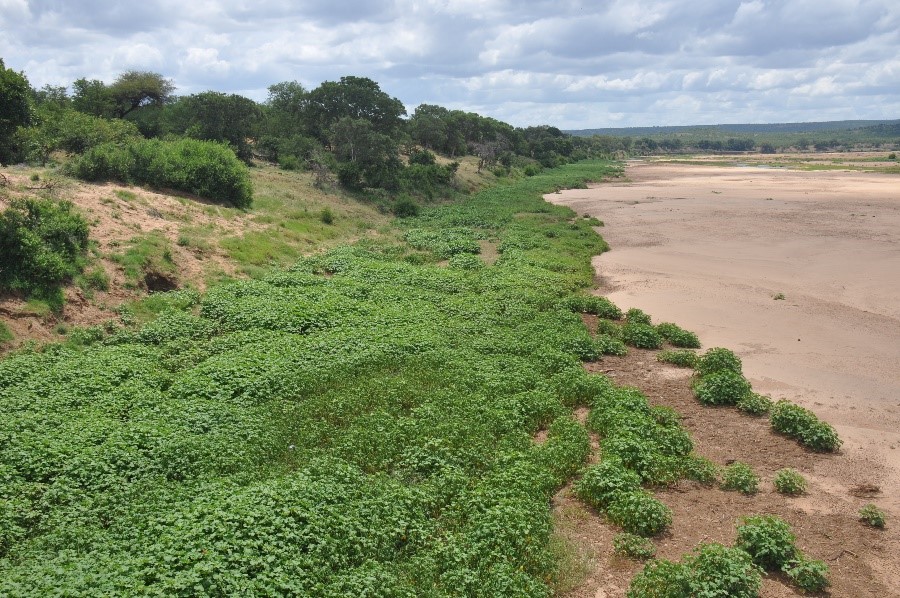
Xanthium strumarium along the Letaba River
Our objective was twofold, 1) to identify differences in the metabolomic profiles of plants in their invaded vs native habitats, and 2) confirm that our methodology is sensitive enough to detect patterns in metabolomic profiles and may differentiate populations of different regions. This is so we may evaluate whether invasive plants adapt their secondary metabolism to provide better defense against unique biotic and abiotic stresses encountered in the invaded habitats.
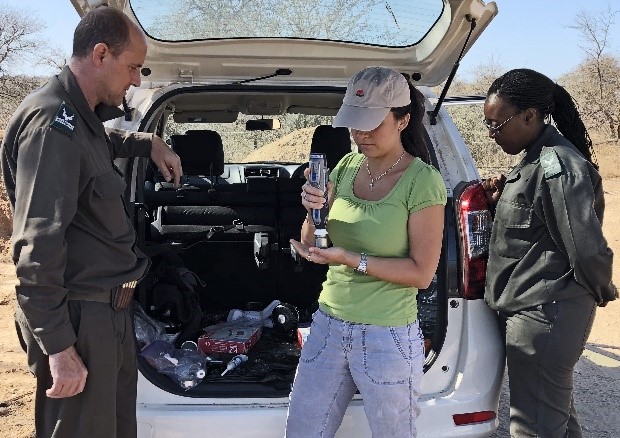
Samples were collected using Rapid Metabolome Extraction and Storage (RAMES) technology, and phytochemical diversity was determined by statistical analysis of their metabolomic profile.
Our findings showed that all populations collected from invaded habitats in KNP held greater phytochemical diversity than native populations. The methodology used was also sensitive enough to distinguish not only continentally different populations, but also populations collected in different regions of the same continent, potentially indicating distance from origin influences the degree of change observed in the metabolomic profile. Increased metabolomic diversity in the invasive regions suggest IAS may employ metabolic flexibility and/or rapid, adaptive evolution to succeed as alien invaders. Metabolic flexibility is an advantage in counteracting the different stresses encountered in the invaded habitat versus the native region. A larger chemical repertoire also makes invasive plants superior to the native species of the invaded area, as they are more equipped to face any challenges in the environment. It is not clear whether the differences in the biochemical composition between US and SA populations represent inherited genetic changes related to natural selection or reflect reversible epigenetic adaptations to environmental stresses, or are just coincidental with invasive behavior. Further research can address this by growing US and SA plants of the same species side by side experimentally in controlled environments.
Reference
Skubel, S. A., Su, X., Poulev, A., Foxcroft, L. C., Dushenkov, V., & Raskin, I. (2020). Metabolomic differences between invasive alien plants from native and invaded habitats. Scientific Reports, 10(1), 1-9. https://doi.org/10.1038/s41598-020-66477-w
