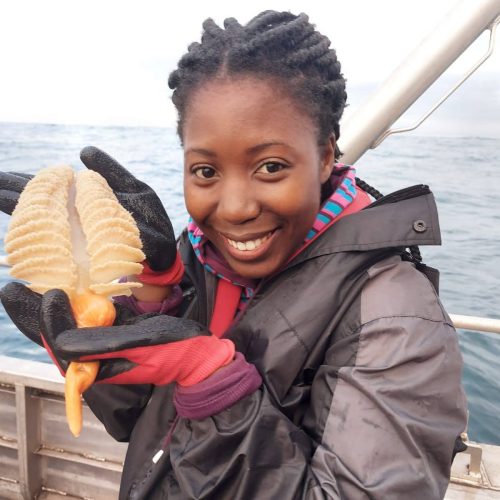
Exploring African Seamounts on the OceanXplorer
From January 30th to the 23rd of February, OceanXplorer and OceanQuest hosted 18 visiting scientists from nine different nations on the first Science Leg of the “Around Africa Expedition.” Led by a South African scientist from the South African Environmental Observation Network (NRF-SAEON), Dr Lara Atkinson, this expedition aimed to improve our understanding of seamount biodiversity and geological features in the largely unexplored Southern Indian Ocean. Additionally, it sought to provide valuable data for marine science, conservation planning, and sustainable management of oceanic resources.
I had the incredible opportunity of being 1 of the 13 Early Career Ocean Professionals (ECOPs) on the science team, 12 of which were from 6 African countries. My participation was funded by POGO (Partnership for Observation of the Global Ocean). We sailed from Comoros to Cape Town, spending 27 days exploring Waters Shoal, the Madagascan Ridge and the Africana Seamount. During this expedition we deployed a Remotely Operated Vehicle (ROV), two submersibles and a CTD (conductivity, temperature and depth sensor), from which we collected over 200 biological samples (sponges, soft and hard corals, brittle stars, feather stars, polychaetes, squat lobsters and more), hundreds of litres of water, sediment cores, and even rocks! Additionally, a total area of 33 137.4 sq km was mapped using high-resolution multibeam sonar.
The science team focused on various aspects of marine research such as environmental DNA (eDNA), nutrient analyses, zooplankton sampling, microbial ecology, soft and hard coral taxonomy, seafloor mapping, geology and fish identification. Each teammate found their niche on the vessel, which made learning from each other (ECOPs, experienced scientists, and OceanX crew) seamless. Therefore, I was able to assist in every aspect of research, including being an ROV lead, where I worked with the ROV pilots to achieve the objectives of a specific dive, and spending 8 hours in a research submersible that descended to a depth of 500 m! Investigating Walters Shoal from this lens was both humbling and inspiring. This once-in-a-lifetime experience will remain the highlight of my career for years to come.
OceanX advocates using media to educate and connect the world with the ocean. During this expedition, I also formed part of the ship-to-shore live-streaming outreach event coordinated by the NRF-SAEON Egagasini Node. During this event, students from 5 Cape Town high schools could participate in a live ROV dive at Walters Shoal, where they could ask the scientists and pilots any operations and research related questions. I then took the students on a virtual vessel tour, showing them the equipment, labs and mission control room. This provided a rare opportunity for students to experience and engage in deep-sea exploration in real-time and be part of collecting biological samples while on land. In addition to this, it allowed me to connect with the next generation of explorers.
This experience was more than just a scientific mission; it was a journey of discovery, collaboration and what technology can help us achieve. It was an honour to represent SANParks on this expedition, and I am excited to see how the findings of the expedition will contribute to the future of deep-sea marine conservation and research in Africa.

The visiting Science team and OceanX crew on the 1st day of the expedition.
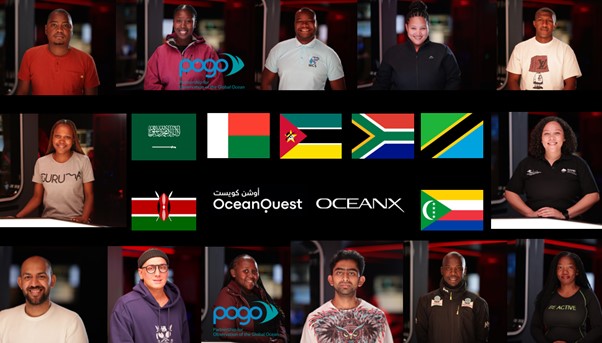
Early Career Ocean Professionals (ECOPs) from 7 different countries that were part of the science team for the Around Africa Expedition. Two of the ECOPs were funded by POGO (Partnership for Observation of the Global Ocean).

Biological samples retrieved from the ROV (Remotely Operated Vehicle) and submersibles. Samples are sorted in a cold room before being processed.

Sinothando Shibe and Dr Lara Atkinson holding up a South African flag in a research submersible before diving 500 m along Walters Shoal Seamount.
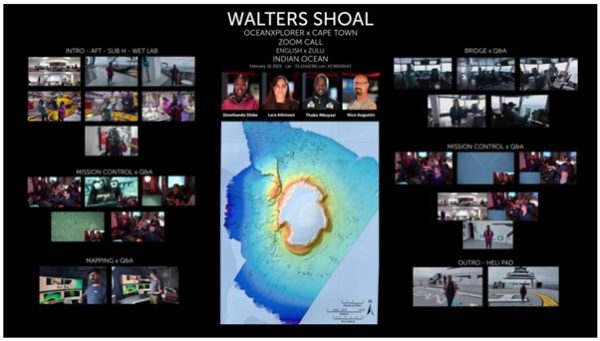
Summary graphic of the Live Streaming Ship-to-Shore event facilitated by NRF-SAEON (South African Environmental Observation Network) aboard the OceanXplorer.