Conversations about biodiversity data management – a roadshow to the four Scientific Services research nodes
In April and May of 2023, Judith Botha and Dian Spear went on a roadshow to the four research nodes of Scientific Services: the Arid and Central Node in Kimberley (19-120 April 2023), the Cape Research Centre in Tokai, Cape Town (4-5 May 2023), the Rondevlei Office of the Garden Route and Frontier Research Unit (8-9 May 2023) and Skukuza Office of the Savanna and Grassland Research Unit (18-19 May 2023). The goal of the quest was to improve data management practices being conducted by Scientific Services staff, discuss challenges staff are having managing data and expose staff to resources that can be used to collate biodiversity data and manage their biotic and abiotic data.
The importance of Scientific Services effectively managing biodiversity data was clear in discussions, and there were some recurring themes of discussion that came up at the four data management workshops.
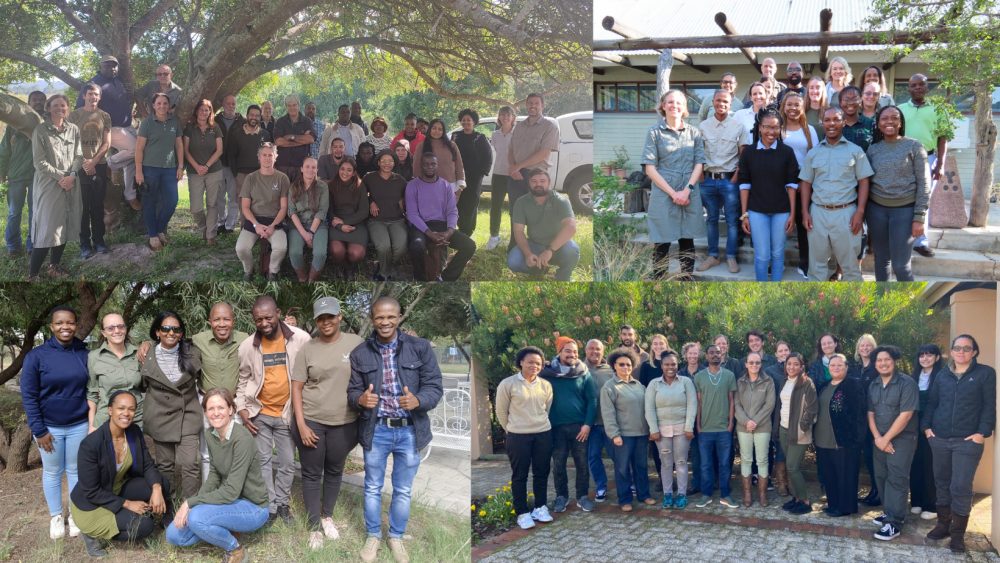
SANParks Scientific Services staff at data management workshops at the four research nodes. Top, Left: Rondevlei office in the Garden Route, Top, right: Skukuza in Kruger National Park, Bottom, Left: Kimberley office, Bottom, Right: Cape Research Centre in Tokai, Cape Town.
Biodiversity data is needed for decision-making
Scientific Services staff, including regional ecologists, who work at the science-management interface, emphasised that data is needed when decisions need to be made. A point was also raised that decisions can take longer when data isn’t at hand. However, it was also mentioned that, for many decisions that need to be made, the relevant data has not yet been collated or is not easily available. The need for data to be made available to managers was emphasised by SANParks scientists as being one of the core functions of Scientific Services and it was mentioned that everything Scientific Services does is underpinned by data.
The marine environment needs more monitoring
At the data management workshop at the Cape Research Centre, the need for a unique focus on the marine environment stood out as important. It was pointed out that marine ecosystems have not received the same amount of attention as terrestrial environments in SANParks. For example, the marine environment is given little mention in park management plans. Marine protected areas (MPAs) are different to terrestrial protected areas in their history of protection and data collection. They have not been subjected to the same level of study as terrestrial systems. Additionally, MPAs contribute to food security, as they provide breeding grounds for fish with spill over to surrounding areas.
Mention was made of South Africa being committed to protecting 30% of the coastline by 2030. Currently, 5,4% of the coastline is protected and there is push back from communities to expand the extent of marine protected areas. The expansion of MPAs also requires having biodiversity data to inform conservation planning decisions on where to place them. Alison Kock explained that a monitoring programme focused on MPAs to provide an evidence base of marine biodiversity data is needed with a focus on food security, as MPAs help provide food security. Additionally, SANParks needs to continue collaborating with colleagues from Department of Fisheries, Forestry and Environment (DFFE), South African Environmental Observation Network (SAEON), and South African Institute of Aquatic biodiversity (SAIAB) to ensure effective management of and access to marine biodiversity data.
Scientific Services needs to engage more with park staff on data collection
A common thread through the workshops was the need for Scientific Services staff to engage with and train park staff, including section rangers and environmental monitors, on the importance of data collection and best practice of data collection. It was highlighted that park staff often don’t understand the importance of collecting data and that they are more inclined to collect data if they can see evidence of what the data they collect is being used for.
There is more engagement between Scientific Services staff and park rangers in Kruger National Park than most other parks. Chenay Simms has been putting together biodiversity reports for Kruger National Park using ranger reports, CyberTracker data from rangers and iNaturalist data and sharing these biodiversity reports with rangers. Rangers appreciate the feedback and make comments about certain sightings on iNaturalist and engage on possible errors in the data. Scientific Services staff have experienced that if nothing is done with collected data and no feedback is provided to rangers, then they stop collecting the data, whereas positive feedback encourages them to keep collecting data and practice better data collection procedures.
Without appropriate training on data collection some collected data will be meaningless. Staff spoke about how the approach to data entry determined whether data could be used. For example, in the Garden Route, gillnet compliance is monitored but information isn’t always provided on how often checks are conducted. If data isn’t collected on sampling effort, then you are not aware of the 0 values. The same is the case for rainfall monitoring. When rainfall data is only entered when there is rainfall, then you don’t know about the times the rainfall gauge was checked and there was no rainfall or the days there was rainfall but the rainfall gauge wasn’t checked. Examples were provided for parks where rainfall data couldn’t be used.
Participants of the data management workshops suggested that data collection training be included in the key performance areas (KPAs) of park managers, section rangers and other staff who supervise and work with rangers and environmental monitors that collect data. It was also mentioned that ranger and environmental monitor KPAs should include data entry best practice. Participants of the workshops also suggested that protocols and manuals are needed as well as engagement in more parks between Scientific Services and park staff, including the revitalisation of science-management meetings. Interestingly, it was mentioned that, in Kruger, there are ranger champions, who help other rangers resolve issues with CyberTracker data entry and upload.
Maintaining institutional memory requires data management and internal reporting
We discussed the Zotero reference management system that has been set up to archive and store useful documents. As well as scientific publications and scanned historic documents, there is a Zotero library for internal reports. It was mentioned that internal reports provide a mechanism for storing institutional memory. While discussions included the need for more internal reports to be compiled, it was suggested that Scientific Services staff also need to capture records of decisions, such as notes from meetings minutes that include reason for decisions, such as what the motivation is for particular animals to be moved, managed or removed or for borehole closures or the reason why a particular application for development was not approved in a park. Staff mentioned that situations repeat themselves and the information, expert opinion and evidence gathered from a previous decision-making process is often not easily available. This is also important because of the need to provide the public with access to information on why decisions were made and what evidence is behind the decision, especially in cases where there are legal challenges. Along with records of decisions, it was mentioned that it is also important to record and store position statements, management briefs and science-management meeting minutes.
One of the major issues relating to institutional memory and SANParks’ need to enhance data management processes is the situation that arises when staff leave. There have been many instances of loss of data and institutional memory when data and documents have not been adequately recorded and saved along with sufficient metadata.
Another relevant suggestion about institutional memory was put forward by Johan Baard: the idea of creating a database of photographs with coordinates, where possible, and a specific naming system. For example, a photograph could be named with key terms, such as scenic coastal mountains.
SANParks Scientific Services needs more capacity for data management
Something that came up resoundingly and recurringly at all four of the research nodes was the lack of capacity to be able to address the data management needs of Scientific Services. Some staff were overwhelmed by the thought of having to organise their data and emphasised the amount of time required to get on top of data management. However, it was also mentioned that data management is an integral part of a scientist’s job and that if we want to do it properly, then we need time to do it properly.
