Challenges and Insights from Whale Carcass Management in South African Marine Protected Areas
In September 2019, a dead humpback whale washed ashore in South Africa’s Tsitsikamma Marine Protected Area (MPA), a hotspot for both tourism and conservation. The stranding highlighted the complexities of managing whale carcasses within protected areas but provided a learning opportunity to further our understanding of public perception, monitor decomposition, and ultimately offer insights into improved practices for future whale stranding events.
Understanding the Challenge of Whale Carcass Management
Whale strandings occur naturally along coastlines globally, offering essential ecosystem benefits. Decomposing whale carcasses supports marine and coastal life, providing nutrients for species from seabirds to marine invertebrates. However, these natural processes often clash with human interests, especially in areas with high public visibility and tourism activity. In particular, concerns arise due to the unpleasant sight, smell, and the possibility of increased shark activity around the carcass.
Typically, whale carcass management becomes particularly challenging due to the multiple social, ecological, financial, and logistical considerations that need to be taken into account. Decisions around whether to intervene often depend on various factors, including public health, tourism impacts, environmental laws, and logistical feasibility.
The Stranding Event and Initial Responses
The Tsitsikamma MPA, where the carcass stranded, is a major tourist attraction with camping areas, hiking trails, and water-based activities such as kayaking and snorkeling. The carcass, estimated at 11–12 meters long and weighing up to 25 tons, raised immediate concerns among park management and tour operators about potential tourism impacts.
Upon inspection, management faced several obstacles in moving or disposing of the carcass. The steep, rocky terrain, limited access, and its location in a rocky gully, combined with wave action, made removal by land or sea highly risky. Other options, including burning or burial, were also dismissed due to feasibility and ecological implications. After consulting with various stakeholders, including government bodies, a decision was made to leave the carcass to decompose naturally.

The humpback whale carcass wedged in a gully within the Tsitsikamma Marine Protected Area. Photo by Kyle Smith.
Tourists’ Perspectives on Carcass Management
To understand public perception, 80 tourists were interviewed during their visit to the MPA, exploring their views on carcass management before and after receiving information on the situation. Initially, half of the participants favored leaving the carcass to decompose naturally, while about a third suggested intervention to remove it. Key reasons for preferring removal included the unpleasant smell and emotional discomfort associated with seeing a dead whale.
After receiving additional context about the ecological role of whale carcasses and the logistical difficulties of removal, 54% of the tourists initially in favor of intervention changed their stance, preferring natural decomposition. This shift highlights the importance of public awareness and educational outreach, which can significantly influence public opinion on ecological management decisions.
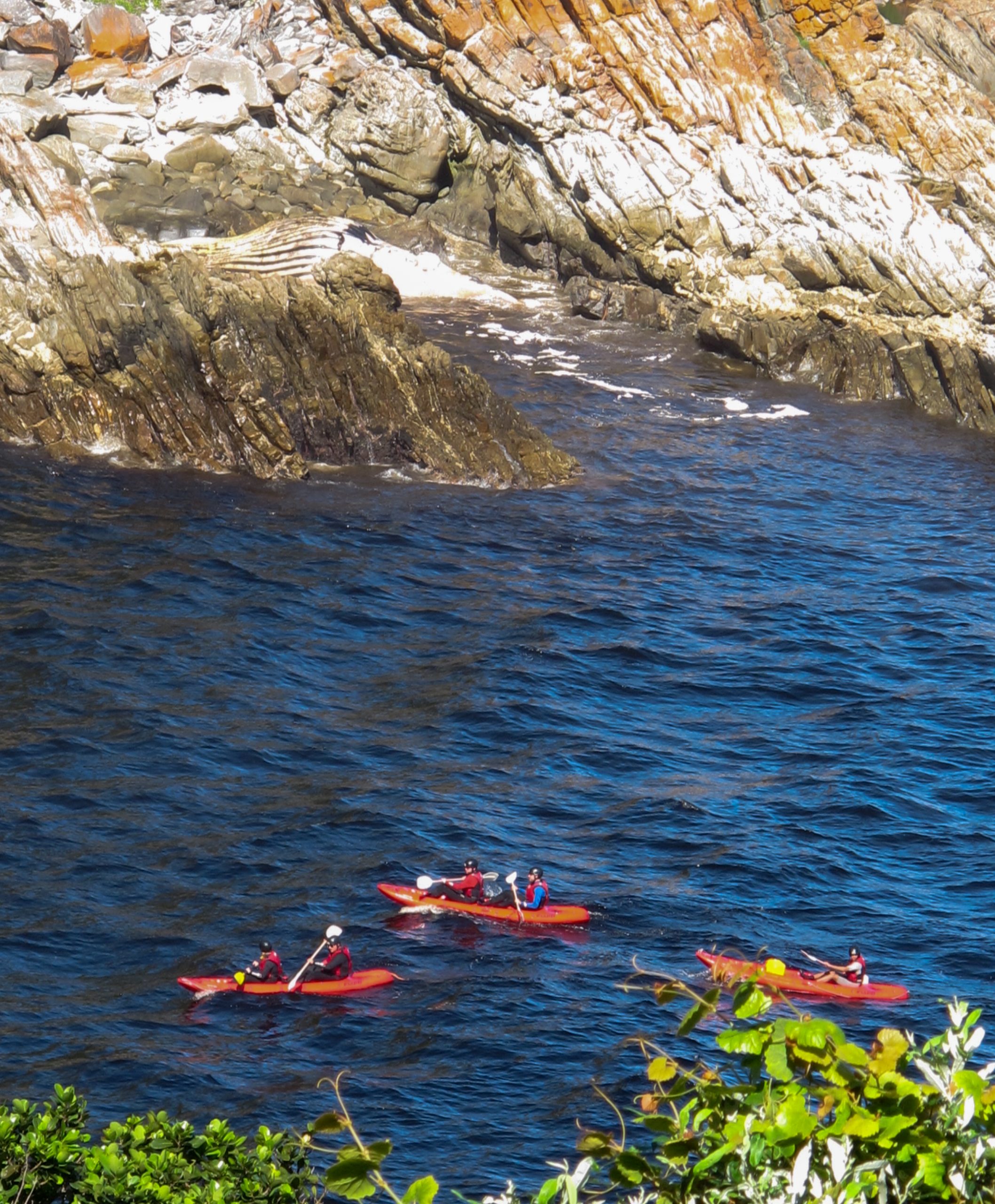
Tourists on a kayak trip paddling past in close proximity to the whale carcass. The safety of tourists was a concern due to the potential increase in shark activity around the carcass. Photo by Kyle Smith.
Observations on Carcass Decomposition
Over a 70-day period, the decomposition of the carcass was monitored. Initially, there was minimal change, but within three weeks, the carcass began to break apart. By day 29, fish were observed feeding on the remains, and bones started washing ashore. The rapid disintegration was attributed to constant water movement pushing the carcass against the rocky shore. By day 70, only bones remained, and the rocks initially covered in whale fat had begun to host green algae, signaling a return to natural conditions.
This observation period provided valuable insight into the decomposition process in a coastal environment, which was faster than anticipated. Such information is useful for future management decisions, particularly in assessing the duration and environmental impact of leaving carcasses in place.
Development of a Decision-Support Tool
Based on the experience gained from this stranding event, a decision-support tool was developed to aid future carcass management. This tool recommends a structured assessment process, starting with identifying whether the carcass is in a protected area, evaluating public safety, and considering ecological impacts.
Stakeholder involvement is an additional critical recommendation. In this instance, early and transparent collaboration with all involved parties, including government and local tour operators, led to an informed and accepted decision, fostering a collaborative learning environment. This approach helped mitigate potential conflicts by including diverse perspectives in the decision-making process.
Recommendations for Future Management
This study provides several actionable recommendations for managing future whale strandings:
- Educate the Public: Providing context around the ecological benefits of whale carcasses and explaining the decision-making process can shift public attitudes toward favoring natural decomposition, reducing pressure for immediate intervention.
- Communication Strategies: Developing a clear communication plan can help manage tourist expectations, turning a potential disturbance into an educational opportunity. Many tourists showed curiosity about the whale carcass, suggesting that educational resources could enhance the visitor experience while increasing support for conservation.
- Guidelines and Protocols: Developing protocols, such as spatial maps for identifying suitable management actions in different areas, can streamline response efforts. The decision-support tool developed in this study can assist authorities in evaluating each stranding on a case-by-case basis, balancing ecological, social, and logistical factors.
- Further Research: More studies are needed to understand the social, ecological, and logistical impacts of whale carcass decomposition in different environments, especially rocky versus sandy shorelines. This knowledge would provide insights into ecological benefits and potential risks, helping to inform guidelines for sustainable carcass management.
- Stakeholder Collaboration: Including diverse stakeholders, from conservation agencies to local businesses, in the decision-making process improves transparency and acceptance of management decisions. This collaborative approach also allows different knowledge bases to inform responses, making the process more robust.
Conclusion
Managing whale carcasses in public and protected areas like South Africa’s Tsitsikamma MPA poses unique challenges. This study highlighted the complexities of balancing ecological processes with human interests, emphasizing the need for context-specific, scientifically-informed decision-making. By promoting education, improving communication, and fostering collaboration among stakeholders, authorities can enhance public support for natural decomposition processes. This approach respects both the ecological value of whale carcasses and the human activities that occur around them, supporting the sustainable management of marine protected areas.
Link to online paper: https://www.ajol.info/index.php/ajms/article/view/281656
