Arid parks on fire: Mokala National Park and Kgalagadi Transfrontier Park
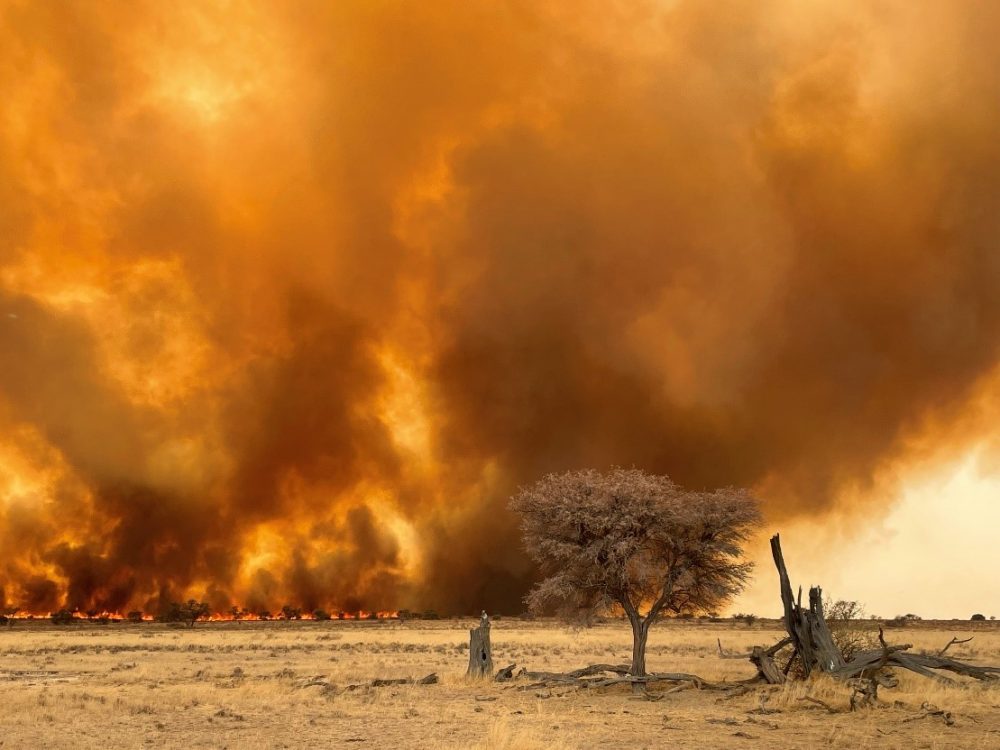
Fire rages across the Kgalagadi Transfrontier Park filling the air with smoke (Photo credit: Dan van der Vyver).
Fire is a widespread and natural disturbance in most sub-Saharan ecosystems. It can have positive and negative effects on an ecosystem.
The disturbance caused by fire can lead to nutrient cycling and cause positive changes in vegetation structure and composition.
However, when fire is mismanaged or uncontrolled, it can be detrimental to the ecosystem.

Mokala after the 2022 fires (Photo credit: Nkabeng Mzileni).
In 2022 and 2023, fires were documented in the Kgalagadi Transfrontier Park and Mokala National Park. In these arid and semi-arid landscapes where Mokala and Kgalagadi are situated, the time between successive fires is influenced by latitude and rainfall, causing fire interval to follow a latitudinal rainfall gradient. The seasonality of rainfall in these parks follows a 7-to-10-year cycle in accordance with the El Nina and El Nino cycles.

Fire in Kgalagadi moving across the Nossob riverbed from Botswana westward through South Africa towards Namibia (Photo credit: Dan van der Vyver).
Precipitation and temperature drive the accumulation of biomass, which fuels fire. Rainfall in the arid and semi-arid environment tends to be associated with lightning, which triggers natural fires that can be extinguished by the subsequent rain. However, anthropogenic fires are more challenging, especially when they burn under hot, dry and windy weather conditions. These fires are particularly problematic when biomass is extremely high following many years of fire exclusion or high rainfall.
Mokala National Park

Fires occur periodically in Mokala National Park following years of high rainfall (Photo credit: Nkabeng Mzileni).
Fire in semi-arid environments is part of the natural system, and fire frequency follows a latitudinal rainfall gradient. Mokala falls within the Savanna and Nama-Karoo biomes and receives summer rainfall with annual average rainfall ranging from 233 mm to 558 mm per year. After Mokala was proclaimed in 2007, there was a brief period of above average rainfall (average 406 mm) until 2013 followed by a severe drought (average 271 mm) until 2019. Since 2020, Mokala has experienced above average rainfall (average 537 mm), which is anticipated to decrease again in accordance with cyclical fluctuations.
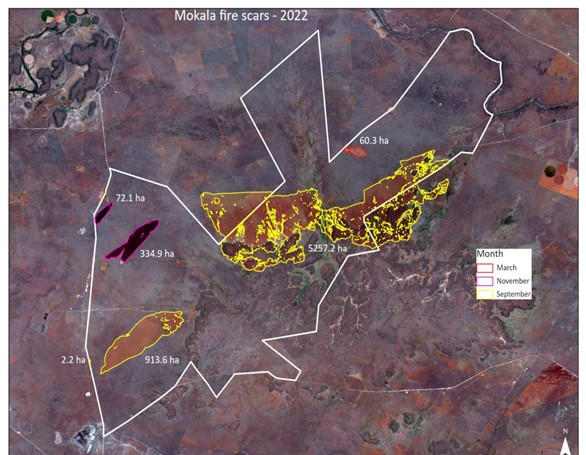
Fire scars in Mokala National Park from March, September and November 2022. The extent of the fires in 2022 inside the park was approximately 6638.1 ha spread over different incidences.
There are multiple causes of veld fires in Mokala National Park:
- Accidental fires from external sources (neighbouring properties)
- Accidental fires from internal sources (electrical cables)
- Lightning fires inside the park
- Lightning fires outside the park and then burnt into the park
Lightning fires inside Mokala are normally quickly contained or extinguished by rain following the lightning strikes. However, dry lightning is a threat, and significant effort is put into containing such fires and preventing them from exiting the park as dry air and strong wind conditions during dry lightning strikes are favourable for the spread of wild veld fires.
Kgalagadi Transfrontier Park
The Kgalagadi Transfrontier Park is situated in the arid to semi-arid southern Kalahari region. The southwestern Kalahari falls within a summer rainfall area and the mean annual rainfall ranges from 120 mm in the southwest to 350 mm in the northeast into Botswana. Rainfall is highly erratic and at a specific locality can vary from less than a 100 mm up to more than 450 mm per annum. Annual rainfall has a high coefficient of variation and the rain often falls as short–duration, high-intensity thunderstorms.

Smoke from the fire in Kgalagadi Transfrontier Park in 2022 (Photo credit: Dan van der Vyver).
Fire is a rare but natural phenomenon in the region, occurring predominantly in above average rainfall years after sufficient fuel loads have accumulated. High rainfall was experienced in the Kgalagadi starting from 2021 and into 2022.
The 2022 fire started after a lighting strike and was driven by strong winds. It crossed over into Botswana over the riverbed in a number of places and into Namibia through the riverbed from east to west across the park but fortunately was stopped. The fire period was characterized by extreme conditions: every day was 39-42 °C with strong, swirling wind in all directions.
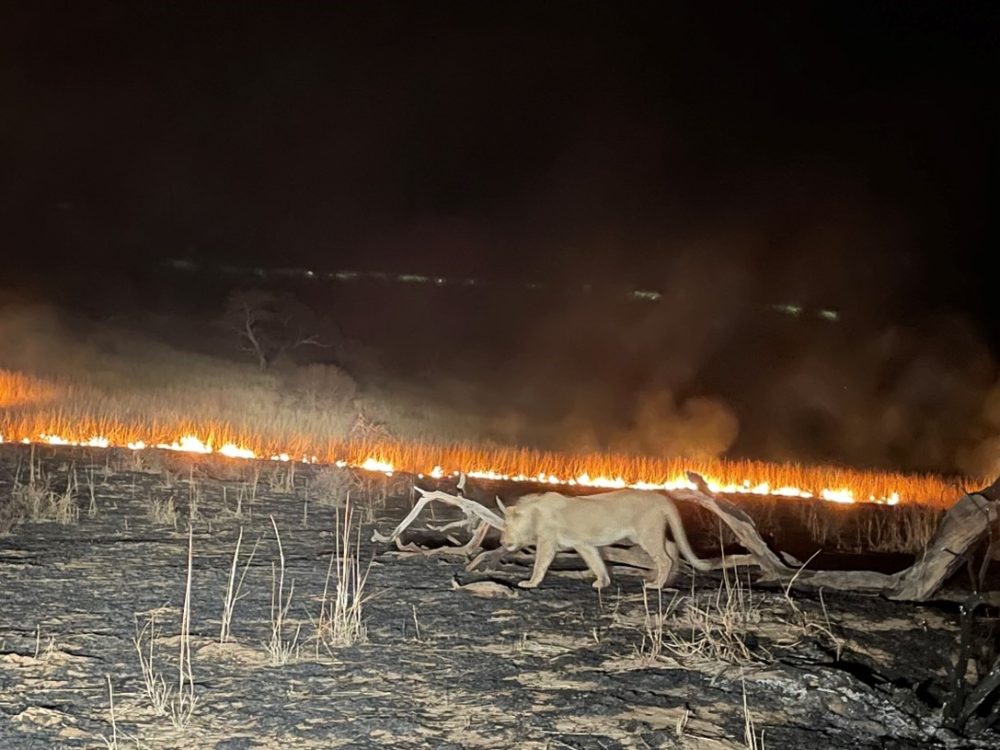
A lion walks in front of the fire in Kgalagadi Transfrontier Park (Photo credit: Dan van der Vyver).
The fire burnt for 13 days from Botswana across the park into Namibia, covering an area of 78914.9 ha. Wildlife was affected by the extent of the fire. However, more roadkill was observed than animals burnt in the fires. Several camel thorn trees were burned in the process and although this initially caused some concerns, post fire monitoring indicated that the number of trees still standing exceeded those that burnt, as the recruitment rate is still high in the park.
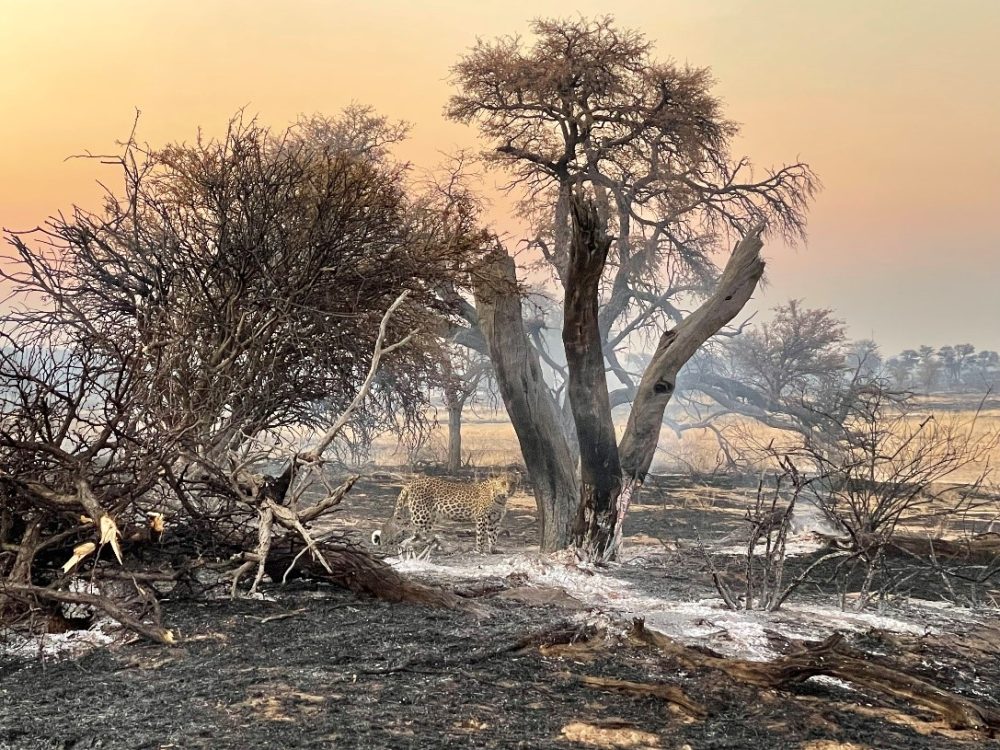
A leopard in Kgalagadi Transfrontier Park after the fire (Photo credit: Dan van der Vyver)
Predators were also out in force following the fires, seemingly hanging around the waterholes of recently burnt areas. Lots of lions were observed throughout the northern parts of the section, as well as cheetahs and leopards. Honey badgers were seen feeding on snakes escaping the advancing fires by catching them when they crossed the road.
The natural disturbance of fire leads to multiple ecological processes, including altering feeding behaviours of herbivores and predators, influencing soil moisture, removal of accumulated plant litter and nutrient cycling.
