A bird in the hand is worth two in the bush
Initially, the students stood in awe of a bird in the hand. Watching closely, University of Mpumalanga (UMP) students were guided through the process of bird capture and ringing; starting with how and where to set up mist nets to trap small passerine birds; safely removing caught birds from the nets; how to handle a live bird; correctly identifying the species; collecting biological data; placing the appropriate uniquely numbered aluminium SAFRING on the bird; through to safely releasing the bird. With each bird that was caught, the students’ enthusiasm to participate grew.
This activity was a first for students studying Wildlife Techniques at UMP and formed part of a larger hands-on field course held at several field sites in and around Skukuza, Kruger National Park. From 15-19 April the students participated in exciting field activities, ranging from rodent and reptile trapping, veld condition assessments, predator call-ups and tracking, bat captures, the use of camera traps, catching and tagging a crocodile and bird identification and ringing.
Professor Bob McCleery (Professor Wildlife Ecology and Conservation at University of Florida) with assistance from several SANParks Scientific Services personnel and staff from the Organisation of Tropical Studies (OTS) coordinated the course, which was hosted at the Skukuza Science Leadership Initiative (SSLI) Campus. Don Williams, the chairman of the Nelspruit Birding Club and registered SAFRING ringer, together with SANParks Avian Research Coordinator, Sharon Thompson, demonstrated the bird mist-netting, handling, and ringing techniques and explained the relevance of the various data collected during bird ringing and how it contributes to science and conservation.
SAFRING (South African Bird Ringing Unit) curates all the southern African ringing records and ensures that ringing takes place under the highest ethical and technical standards. The scientific value of bird ringing lies in the data captured during the ringing process, especially when individuals are recaptured. This informs our understanding of movement patterns and can provide estimates of age and survival rates. With millions of birds ringed and recaptured by ornithologists globally each year, ringing data makes a major contribution to detecting population changes, migration patterns and understanding species declines.
Under Don’s supervision each student was given the opportunity to handle a bird and then to release it back into the wild, while a few students chose to try their hand at measuring the length of the birds’ primary wing feathers and weighing the bird. Smiles from ear to ear signified the remarkable experiential value of observing birds up close and appreciating features never seen before.
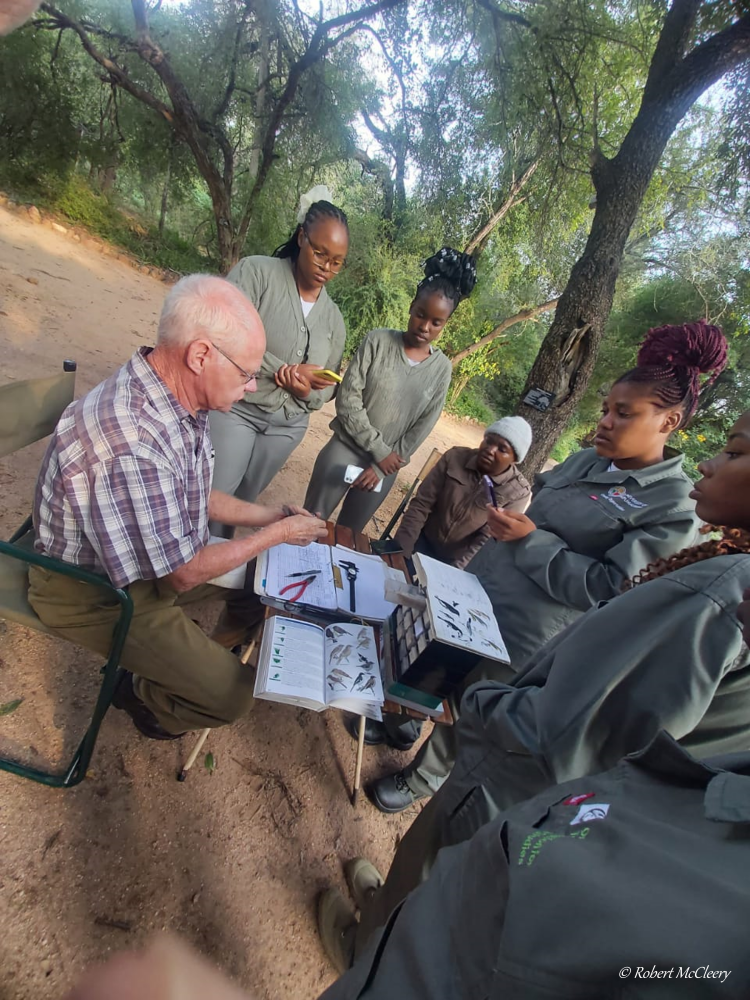
Don Williams (Chairperson of Nelspruit Bird Ringing Club) demonstrating to students during the workshop

